CORAA
Features/Scrutiny/জার্নাল এন্ট্রি টেস্টিং
SA 240 · ICAI স্ট্যান্ডার্ড

জার্নাল এন্ট্রি টেস্টিং

SA 240 পরীক্ষা উপর সম্পূর্ণ journal universe, নয় নমুনা.

CORAA ইন্টেলিজেন্স স্টুডিও জন্য SA 240 জার্নাল এন্ট্রি টেস্টিং

SA 240 requires the auditor to test journal entries for management-override risk. CORAA runs the full JE population through a Benford's-Law leading-digit profile and an entry-level characteristics battery — round amounts, period-end and weekend postings, unbalanced entries, bank movements routed through journal vouchers, seldom-used account pairings, reversals and duplicates. Year-End and Post-Close views focus the riskiest windows, and every flag carries its reason and drills to the voucher.

  • Complete journal universe tested, never sampled
  • Benford's-Law leading-digit profile over the full JE population
  • Characteristics battery: round, period-end, weekend, unbalanced, bank-via-JV, seldom pairs, reversals, duplicates
  • Year-End and Post-Close views focus the high-risk windows
  • Source voucher one click from every flag
  • Working paper documents the procedure per SA 240
Two paths, one ledger

The old way, and ours.

Two paths to the same audit conclusion. One leaves traces; the other doesn't.

Traditional

The old way

  • -SA 240 covered through manual journal sampling on year-end
  • -Article reviews 50-100 manual JEs against an internal checklist
  • -Benford analysis and characteristic screens need separate tooling
  • -Documentation often consists of 'reviewed and accepted' notes
কভারেজ: সীমিত. ঝুঁকি এর অনুপস্থিত earnings-management প্যাটার্ন: বাস্তব. ডকুমেন্টেশন: পাতলা.
CORAA

On the Ledger

  • Every journal entry tested, regardless of count
  • Manual JE filter surfaces user-created entries (vs system-posted) automatically
  • Every characteristic flag states its reason and drills to the voucher
  • Benford deviations highlighted digit by digit, with the contributing entries listed
  • Findings linked to source vouchers with full audit trail
কভারেজ: 100% এর জার্নাল এন্ট্রি. প্যাটার্ন শনাক্তকরণ: deterministic. ডকুমেন্টেশন: সম্পূর্ণ.
How it works

Three steps. Every trace logged.

Step 01

Benford's-Law profile

The full journal population's leading-digit distribution is profiled against Benford's expected curve. Digits that deviate materially are highlighted, with the contributing entries one click away — a population-level screen no sample can give you.

Step 02

Characteristics battery

Each entry is screened for the classic override characteristics — round amounts, period-end and weekend posting, unbalanced entries, bank movements routed through journal vouchers, seldom-used account pairings, reversals and duplicates. Each flag carries its SA 240 rationale.

Step 03

Year-End and Post-Close focus

One-click views isolate the entries posted around year-end and after close — the windows where override risk concentrates. The auditor works the flagged list, dismisses with rationale, and the working paper records everything.

Inside the module

What you actually get.

Manual vs system-posted JE filter

Tally and SAP both distinguish user-created journals from system-posted ones (system journals are typically depreciation, accrual reversals, etc.). CORAA reads the entry's origin and filters the journal universe accordingly.

  • User-posted JE detection
  • Year-End and Post-Close focus views
  • Auto-discards system journals from SA 240 review
  • Source ERP user captured in audit trail

Characteristic rules

Rules anchored to common earnings-management patterns: revenue-recognition shortcuts, expense deferrals, late-period reclassifications, entries against seldom-used accounts. Each rule has an SA 240 paragraph reference.

  • Revenue recognition shortcuts
  • Expense deferral patterns
  • Seldom-used account pairings
  • Late-period reclassifications

Population-level Benford screen

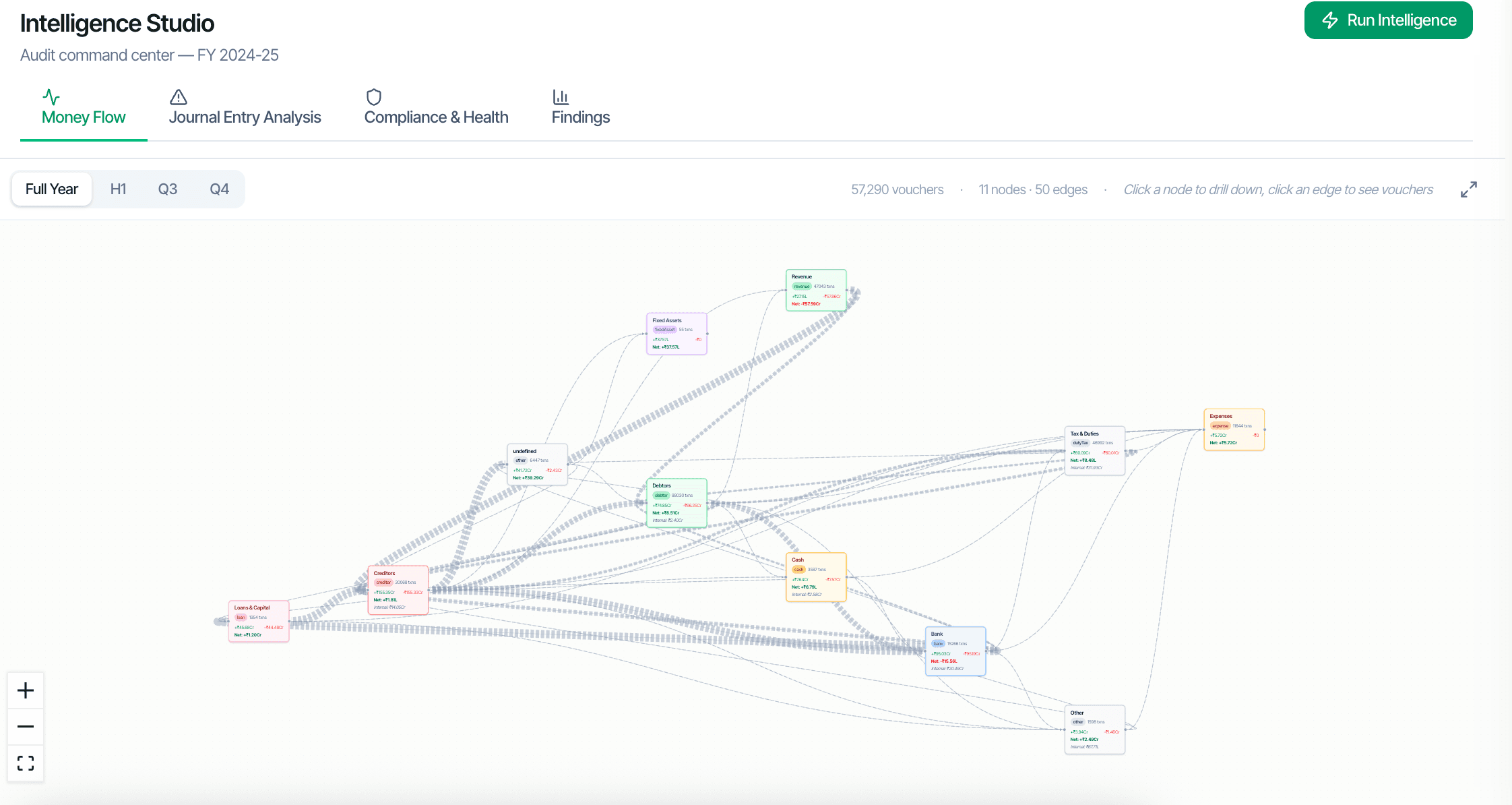
The leading-digit profile runs across every journal entry, not a sample. Deviating digits expand to the entries behind them, each drilling to its voucher — a screen for the auditor's judgment, never a conclusion.

  • Visual graph of RPT flows
  • Digit-level drill to entries
  • Drill from node to voucher list
  • Filter by amount, period, party

SA 240 working paper

The SA 240 Working Paper documents the procedure performed: which window was tested, which rules were applied, which entries were flagged, which were dismissed with auditor rationale.

  • Window and rule set documented
  • Flagged entries listed with auditor disposition
  • Dismissed entries carry rationale
  • Audit trail preserved per SA 230
Frequently asked

Answers, up front.

Both Tally and SAP tag every journal entry with its origin (user-posted vs system-generated). Tally distinguishes via Voucher Type. SAP tags via Document Type (e.g., SA for system, AB for accounting documents posted manually). CORAA reads these tags and filters accordingly. For ERPs without explicit tagging, CORAA uses heuristics (round amounts, posting in the last 14 days, etc.) to identify likely-manual entries.
Year-End isolates entries posted in the closing stretch of the financial year; Post-Close isolates entries dated after the period end. Both are one-click views on the paper — the auditor works a focused list instead of configuring date windows by hand.
The leading digit of every journal entry amount is tallied and compared against Benford's expected distribution. Material deviations are highlighted; clicking a digit lists the entries behind it, each drilling to the voucher. It is a screen, not a conclusion — every flag waits for auditor review.
See it on a real ledger

Run জার্নাল এন্ট্রি টেস্টিং on one of your engagements.

Bring a Trial Balance and a General Ledger. We'll walk through scrutiny end-to-end on your data, not a sandbox.

Run your first audit free →
SA 240 Journal Entry Testing AI for Statutory Audit | CORAA