CORAA
AI Modules/Reporting/CARO 2020
Companies Act · Audit Report· प्रतिवेदन

CARO 2020

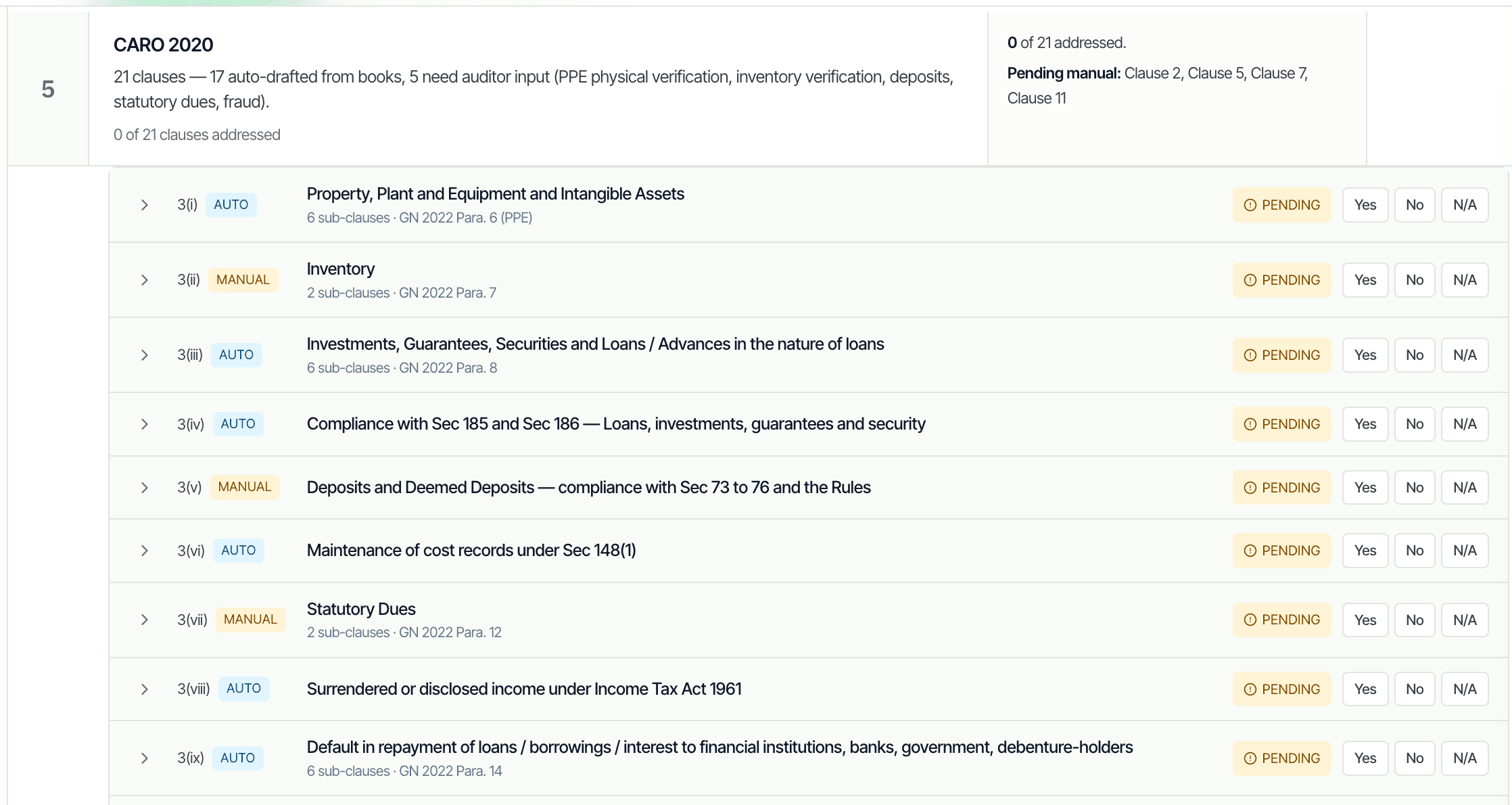
21 reporting clauses. 17 auto-drafted from books. 4 require auditor input.

CORAA CARO 2020 with all 21 clauses

CARO 2020 (Companies Auditor's Report Order 2020) requires reporting on 21 specific clauses across PPE, inventory, loans, deposits, statutory dues, internal controls, fraud reporting, and more. CORAA auto-drafts 17 of the 21 clauses from books and ledger data. The remaining 4 require auditor judgment with documented evidence, physical verification, inventory verification, deposits compliance, and fraud reporting.

  • All 21 CARO clauses with sub-clauses rendered
  • 17 clauses auto-drafted from books, investments, statutory dues, default in repayment, internal audit
  • 4 manual clauses with auditor input, PPE physical verification, inventory verification, deposits, fraud
  • Clause 3(xi)(e), Rule 11(e) ratios variance disclosure auto-populated from Schedule III
  • Each clause anchored to its Companies Act paragraph reference
  • Pending vs Addressed status per clause, partner sees what's outstanding
Two paths, one ledger

The old way, and ours.

Two paths to the same audit conclusion. One leaves traces; the other doesn't.

Traditional

The old way

  • -Senior partner reviews all 21 clauses against books one by one
  • -PPE clause 1 verified against fixed asset register manually
  • -Inventory clause 2 reviewed against physical verification documents
  • -Statutory dues clause 7 chased through TDS, GST, PF, ESI ledgers separately
  • -Rule 11(e) ratios computed manually for variance disclosure
Days of partner time. Clauses sometimes addressed late, just before sign-off.
CORAA

On the Ledger

  • 17 auto-drafted clauses ready for partner review on Day 1
  • Investments, guarantees, securities (Clause 3), pulled from books
  • Sec 185 and Sec 186 compliance (Clause 4), verified against loan ledgers
  • Statutory dues outstanding (Clause 7), auto-computed across TDS, GST, PF, ESI
  • Default in repayment (Clause 9), bank ledger reconciliation
  • Rule 11(e) variances pulled from Schedule III Ratios tab
21 CARO clauses ready for partner review in two hours. NFRA-inspection defensible.
How it works

Three steps. Every trace logged.

Step 01

Books-derived clauses auto-draft

17 of the 21 CARO clauses derive from books and ledger data. CORAA reads the relevant ledgers (loans, investments, statutory dues, current ratio, debt-equity), checks compliance against Companies Act paragraph references, and drafts each clause.

Step 02

Manual clauses prompt for auditor input

4 clauses require auditor input with documented evidence: Clause 1(c) PPE physical verification (auditor confirms with date), Clause 2 inventory physical verification (with discrepancy threshold), Clause 5 deposits compliance, Clause 7 statutory dues partial confirmation, and Clause 11 fraud reporting.

Step 03

Rule 11(e) variance disclosure

Clause 3(xi)(e) requires explanation for any of the 11 financial ratios with variance over 25% vs prior year. CORAA pulls the variances from the Schedule III Ratios tab and prompts the auditor for the explanation; the disclosure feeds Clause 3(xi)(e) directly.

Inside the module

What you actually get.

21 clauses with paragraph anchors

Every CARO clause is anchored to its Companies Act paragraph reference and CN 2022 (Guidance Note 2022) paragraph. The auditor knows exactly which statute is being addressed.

  • Clause 1: PPE and intangibles
  • Clause 2: Inventory verification
  • Clause 3: Investments, guarantees, securities
  • Clauses 4-21: each paragraph-anchored

17 auto-drafted clauses

Investments (3), Sec 185/186 compliance (4), statutory dues (7), default in repayment (9), fund diversion (10), term loan application (11), internal audit (12), and others, all auto-drafted from books data.

  • Investments, guarantees, securities
  • Sec 185 and Sec 186 compliance
  • Statutory dues outstanding
  • Default in repayment of loans
  • Fund diversion check
  • Term loan application
  • Internal audit system

4 manual clauses with structured input

PPE physical verification (Clause 1(c)) requires the auditor to confirm verification date and discrepancies. Inventory verification (Clause 2) similar. Deposits (Clause 5) requires compliance with Sec 73-76. Fraud (Clause 11) requires auditor's reporting under Sec 143(12).

  • Clause 1(c) PPE: verification date and discrepancies
  • Clause 2 inventory: physical verification report upload
  • Clause 5 deposits: Sec 73-76 compliance
  • Clause 11 fraud: Sec 143(12) reporting

Rule 11(e) variance disclosure

Clause 3(xi)(e) was added in 2021, requires explanation for any of 11 financial ratios with variance over 25%. CORAA pulls variances from Schedule III Ratios tab and prompts the auditor for each explanation.

  • Current ratio, Debt-equity, DSCR
  • ROE, Inventory turnover, Receivable turnover
  • Payable turnover, Net capital turnover
  • Net profit ratio, ROCE, ROI
  • Variance flagged at 25%
Frequently asked

Answers, up front.

17 of 21. Clauses 3 (investments and guarantees), 4 (Sec 185/186), 7 (statutory dues), 9 (default in repayment), 10 (fund diversion), 11 (term loan application), 12 (internal audit), 13 (Sec 188 RPT, when RPT list is set), 16 (registration under RBI), 17 (cash losses), 18 (auditor resignation), 19 (financial ratios), 20 (CSR), 21 (qualifications/adverse opinion). The remaining 4 require auditor input.
Clause 1(c) PPE physical verification (date and discrepancies above threshold), Clause 2 inventory physical verification (with discrepancy disclosure), Clause 5 deposits compliance under Sec 73-76, and Clause 14 fraud reporting under Sec 143(12). Each prompts the auditor for the specific evidence required by the Companies Act and the ICAI Guidance Note 2022.
CARO 2020 Rule 11(e) requires the auditor to report on 11 financial ratios with explanation for any variance over 25% vs prior year. CORAA computes all 11 ratios from Schedule III data, flags variances over 25%, and prompts the auditor for the explanation. The disclosure feeds Clause 3(xi)(e) and the Schedule III Ratios tab simultaneously.
Most clauses apply to private companies above the size thresholds. Exemptions: private companies with paid-up capital + reserves ≤ ₹1 crore, borrowings ≤ ₹1 crore from banks/FIs, and turnover ≤ ₹10 crore are exempt from CARO entirely. CORAA reads the thresholds from books and disables CARO if all three are met.
See it on a real ledger

Run caro 2020 on one of your engagements.

Bring a Trial Balance and a General Ledger. We'll walk through reporting end-to-end on your data, not a sandbox.

Start the free trial →Book a walk-through
CARO 2020, 21 Clauses, Auto-Drafted Audit Report | CORAA | CORAA