CORAA
Scrutiny· परख

Scrutiny

Audit firms sample two to five percent. CORAA tests one hundred percent, every ledger, every voucher, every journal.

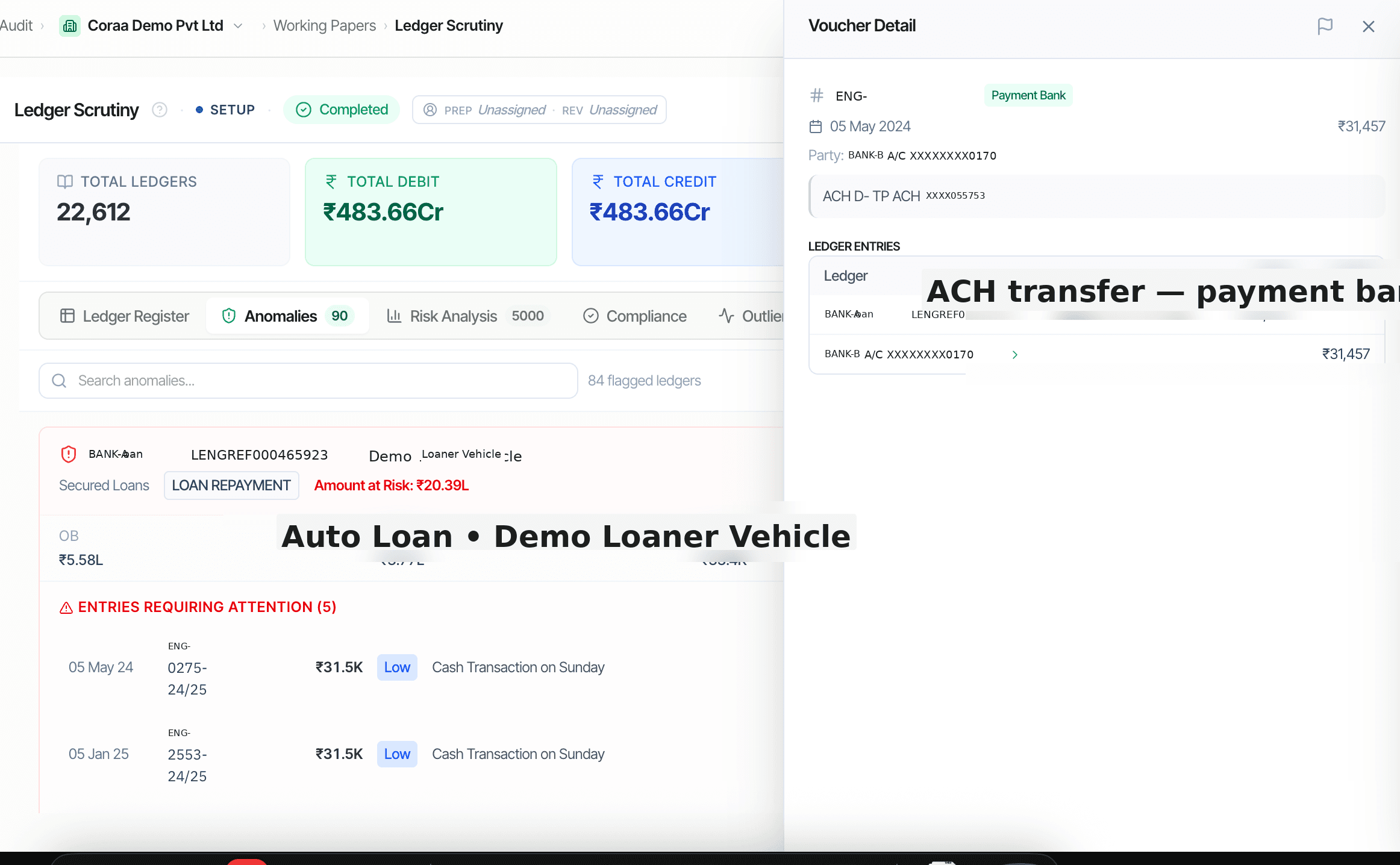
CORAA Ledger Scrutiny with voucher detail drill-down
01·Ledger Scrutiny

Profile every ledger. Surface only the anomalies.

Ledger Scrutiny builds a behavioural profile of every ledger in the General Ledger, movement curves, period-over-period shifts, vendor concentration, frequency of activity. Deviations from that profile surface as a prioritized review list. Auditors no longer scroll through every ledger to find the ten that matter.

  • 100 percent of ledgers profiled, typically 4,000 to 25,000 per engagement
  • Movement profiles render the ledger's normal rhythm
  • Outliers, period spikes, vendor concentration surfaced
  • Prioritized deep-review list with reasons per ledger
  • Voucher detail one click from every flag

Example: Washing Charges average ₹50K-1L per month; January was ₹5L. CORAA flags the five largest invoices for review.

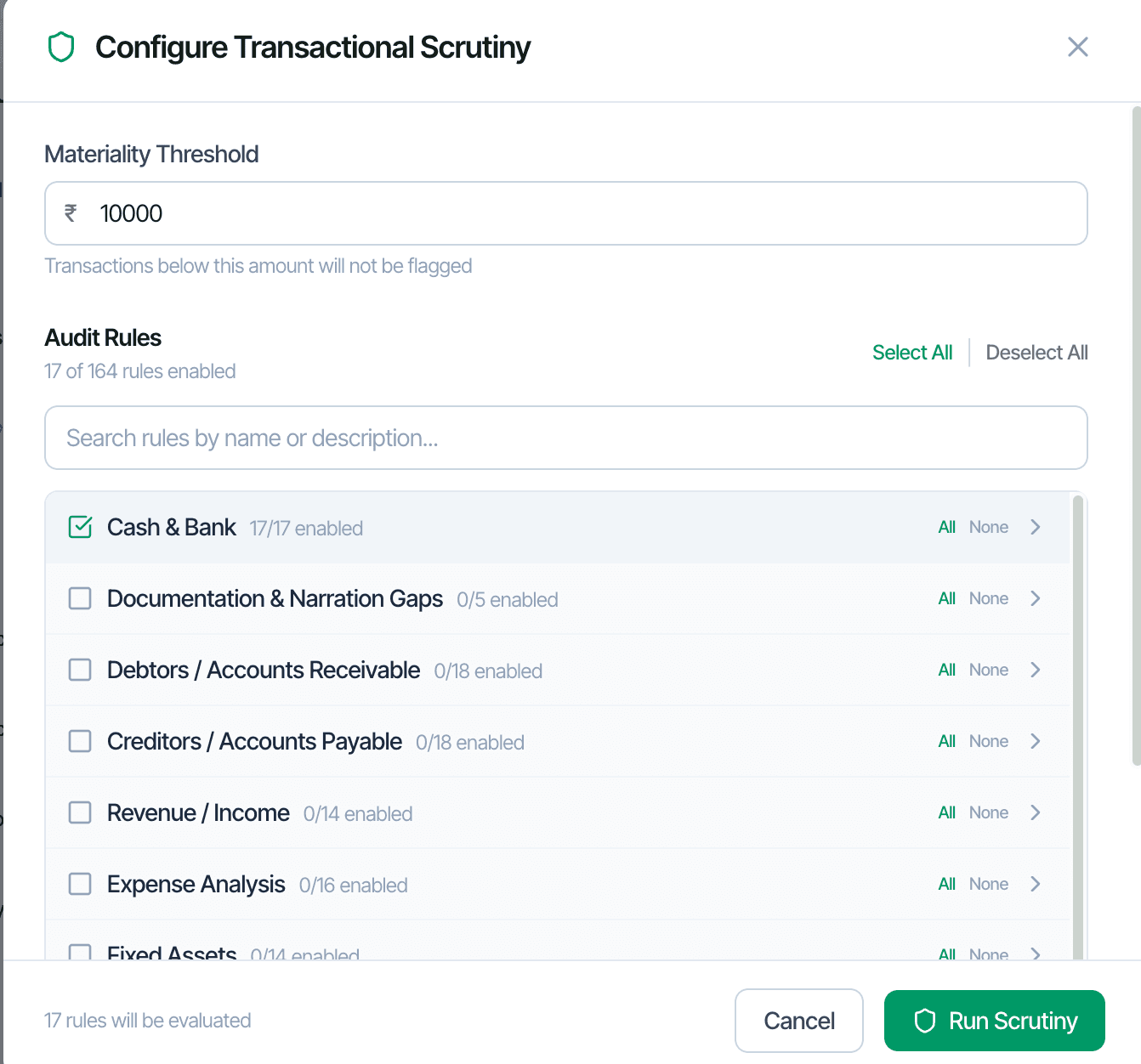
Configure Transactional Scrutiny, 164 rules across 13 modules
02·164 rules · 13 modules

Configure the scrutiny engine per client.

Transactional Scrutiny runs 164 rules across 13 modules, Cash & Bank, Documentation gaps, Debtors, Creditors, Revenue, Expense Analysis, Fixed Assets, and six more. Each rule has an ICAI, Income Tax Act, or GST Act anchor. Rules can be disabled, reweighted, or rethresholded per engagement; the configuration persists for that client.

  • 164 rules across 13 modules, configurable per engagement
  • Each rule anchored to an ICAI Standard on Auditing, IT Act section, or GST provision
  • Disable inapplicable rules, Sunday transactions for retail, for instance
  • Reweight severity per client engagement
  • Configuration persists, no re-setup next year

Rule weights adapt per client. False-flag rates typically drop below 5 percent by the second audit cycle.

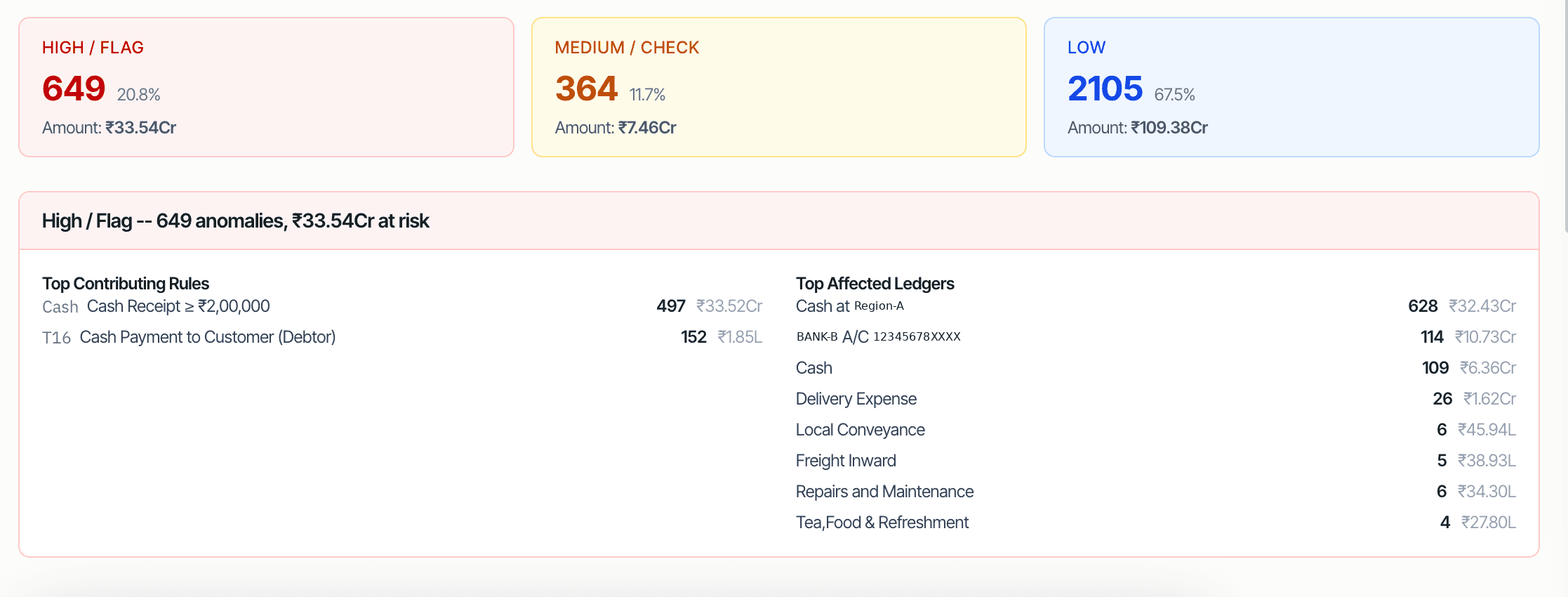
CORAA Severity Dashboard with top contributing rules and most affected ledgers
03·Severity dashboard

Top rules × top ledgers, one view.

Once scrutiny runs, the Severity Dashboard surfaces top contributing rules cross-referenced with top affected ledgers. Auditors see which patterns are driving anomaly volume and where they concentrate. Forensic-quality drill-down to the voucher in three clicks.

  • High / Medium / Low severity bands with anomaly counts and value at risk
  • Top contributing rules ranked by volume and value
  • Top affected ledgers ranked by anomaly count
  • Click any rule to see every voucher it flagged
  • Click any ledger to see every anomaly in that ledger
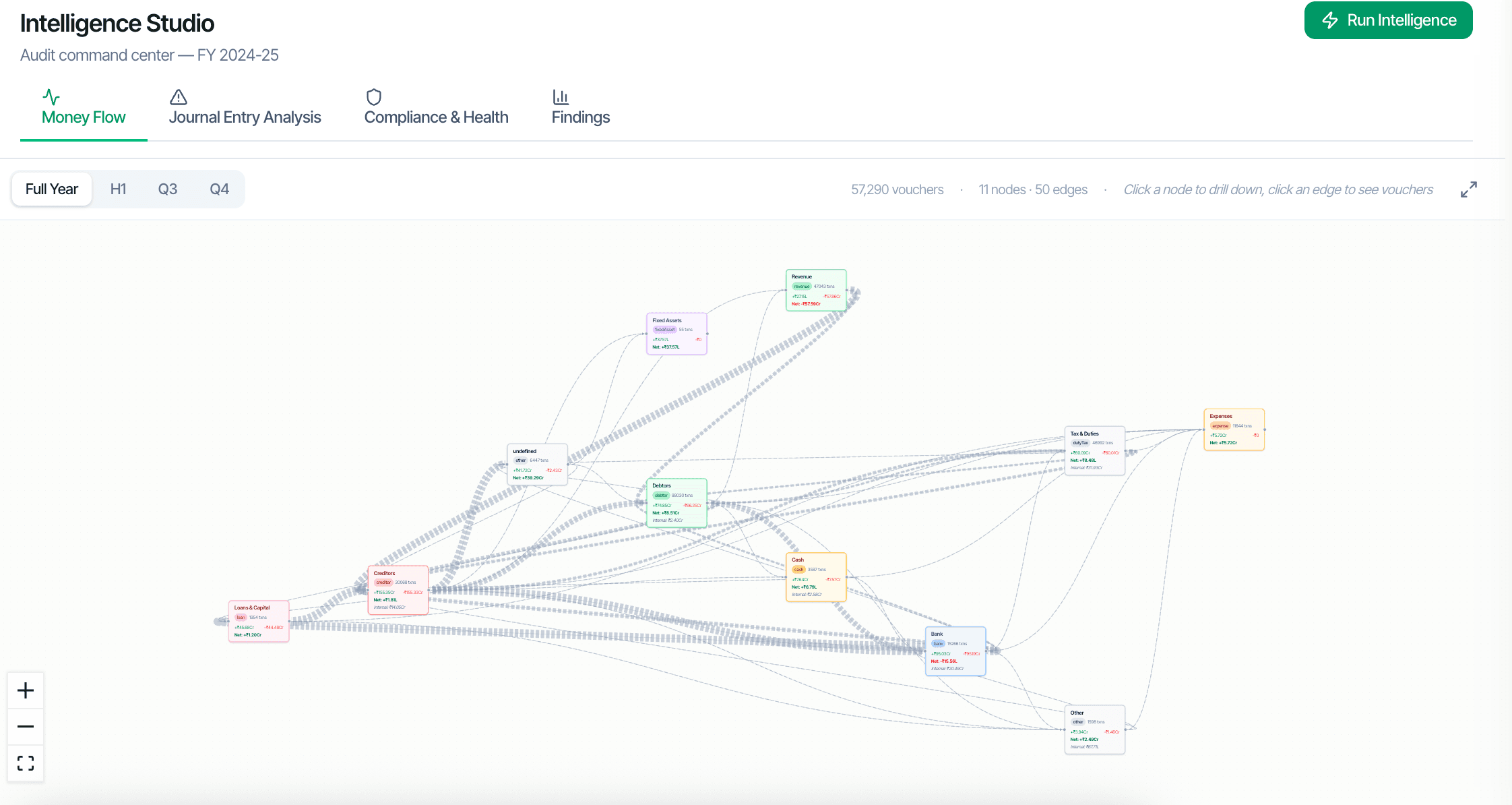
CORAA Intelligence Studio, money flow as a graph for SA 240 testing
04·SA 240

Journal Entry Testing, by the standard.

SA 240 mandates testing of journal entries with three specific risk areas, last-minute manual journals, unusual debit-credit pairings, and related-party rings. CORAA tests the complete journal universe against all three, not a sample. The SA 240 Working Paper documents the procedure with the source vouchers attached.

  • Last-minute manual journals, typically the last 14 days of the FY
  • Unusual debit-credit pairings, signal of earnings management
  • Related-party rings, circular flows when RPT list is set
  • Complete journal universe tested, never a sample
  • Working paper documented per SA 240 with source vouchers attached
Inside Scrutiny

Inside Scrutiny

Four scrutiny engines covering ledger-level, voucher-level, and journal-level testing, all on the complete population.

Frequently asked

Answers, up front.

Yes. Ledger Scrutiny, Transactional Scrutiny, and Journal Entry Testing all operate on the complete voucher universe. For a typical SME audit, this is 50,000 to 200,000 vouchers. Sampling under SA 530 is a separate procedure performed per Working Paper, see the Procedures hub.
Cash & Bank, Documentation and Narration Gaps, Debtors / Accounts Receivable, Creditors / Accounts Payable, Revenue / Income, Expense Analysis, Fixed Assets, TDS, GST, Working Capital, Other Income, Statutory Dues, and Document Trail. Each module groups related rules, for example, Cash & Bank includes cash receipt above ₹2 lakh, weekend payments, threshold breaches, Sunday transactions.
Transactional Scrutiny is the broad 164-rule engine that flags voucher anomalies across all 13 modules. Journal Entry Testing is the SA 240-specific procedure targeting three risk areas, last-minute manual journals, unusual debit-credit pairings, related-party transaction rings. Both run on full population; Journal Entry Testing is the documented procedure for the SA 240 working paper.
Three mechanisms. First, any rule that does not apply can be disabled, weekend transactions for an automobile dealer, for example. Second, a finding can be dismissed as a 'family' so that pattern is suppressed for that engagement permanently. Third, the engine learns from dismissals, rule weights shift down where the auditor consistently marks a pattern as normal. By the second or third audit, false-flag rates typically fall below five percent.
Take it for a spin

Run a live audit. See the working.

Connect one client. Walk through the full audit lifecycle, classification through UDIN sign-off. No decks masquerading as demos.

Start the free trial →Book a walk-through
AI Ledger Scrutiny, Transactional Scrutiny, JE Testing | CORAA | CORAA