CORAA
AI Modules/Working Papers/AR Ageing
Sch III Amendment 2021· पत्र

AR Ageing

Trade receivables ageing buckets per Schedule III ತಿದ್ದುಪಡಿ 2021.

AR Ageing per Schedule III buckets

The 2021 amendment to Schedule III mandates specific ageing buckets for trade receivables: less than 6 months, 6 months to 1 year, 1 to 2 years, 2 to 3 years, and over 3 years. CORAA composes these buckets ಸ್ವಯಂಚಾಲಿತವಾಗಿ. Party-wise ageing unlocks ಟಿಯರ್ II ನಲ್ಲಿ (ಪಾರ್ಟಿ ಮಾಸ್ಟರ್ loaded); bill-wise precision ಟಿಯರ್ III ನಲ್ಲಿ (Bill Register loaded). Receivables over 3 years are auto-flagged as Section 41(1) cessation candidates.

  • Five buckets per Sch III ತಿದ್ದುಪಡಿ 2021
  • Secured, Unsecured, Doubtful classification
  • Party-wise ageing ಟಿಯರ್ II ನಲ್ಲಿ
  • Bill-wise precision ಟಿಯರ್ III ನಲ್ಲಿ
  • Section 41(1) ಆದಾಯ ತೆರಿಗೆ ಕಾಯ್ದೆ cessation candidates flagged
  • Provision for doubtful debts adequacy check
Two paths, one ledger

The old way, and ours.

Two paths to the same audit conclusion. One leaves traces; the other doesn't.

Traditional

The old way

  • -AR ಏಜಿಂಗ್ extracted from accounting system at year-end only
  • -Bucket boundaries set per Sch III ತಿದ್ದುಪಡಿ but applied manually in Excel
  • -Section 41(1) cessation analysis a separate exercise
  • -Provision adequacy assessed on aggregate, not party-by-party
AR ಏಜಿಂಗ್ build time: 2-4 hours. Cessation review: often deferred to Form 3CD finalization.
CORAA

On the Ledger

  • Live ageing computation as of any reference date
  • Secured / Unsecured / Doubtful split per Sch III ತಿದ್ದುಪಡಿ
  • Per-party ageing once ಪಾರ್ಟಿ ಮಾಸ್ಟರ್ loaded
  • Per-invoice ageing once Bill Register loaded
  • Auto-flagging of receivables over 3 years for Sec 41(1) review
AR ಏಜಿಂಗ್ instant. Cessation candidates surface before fieldwork concludes.
How it works

Three steps. Every trace logged.

Step 01

Reference date selection

Pick the Balance Sheet date (typically March 31) or any other reference date. CORAA computes the days outstanding for every receivable as of that date.

Step 02

Bucket allocation

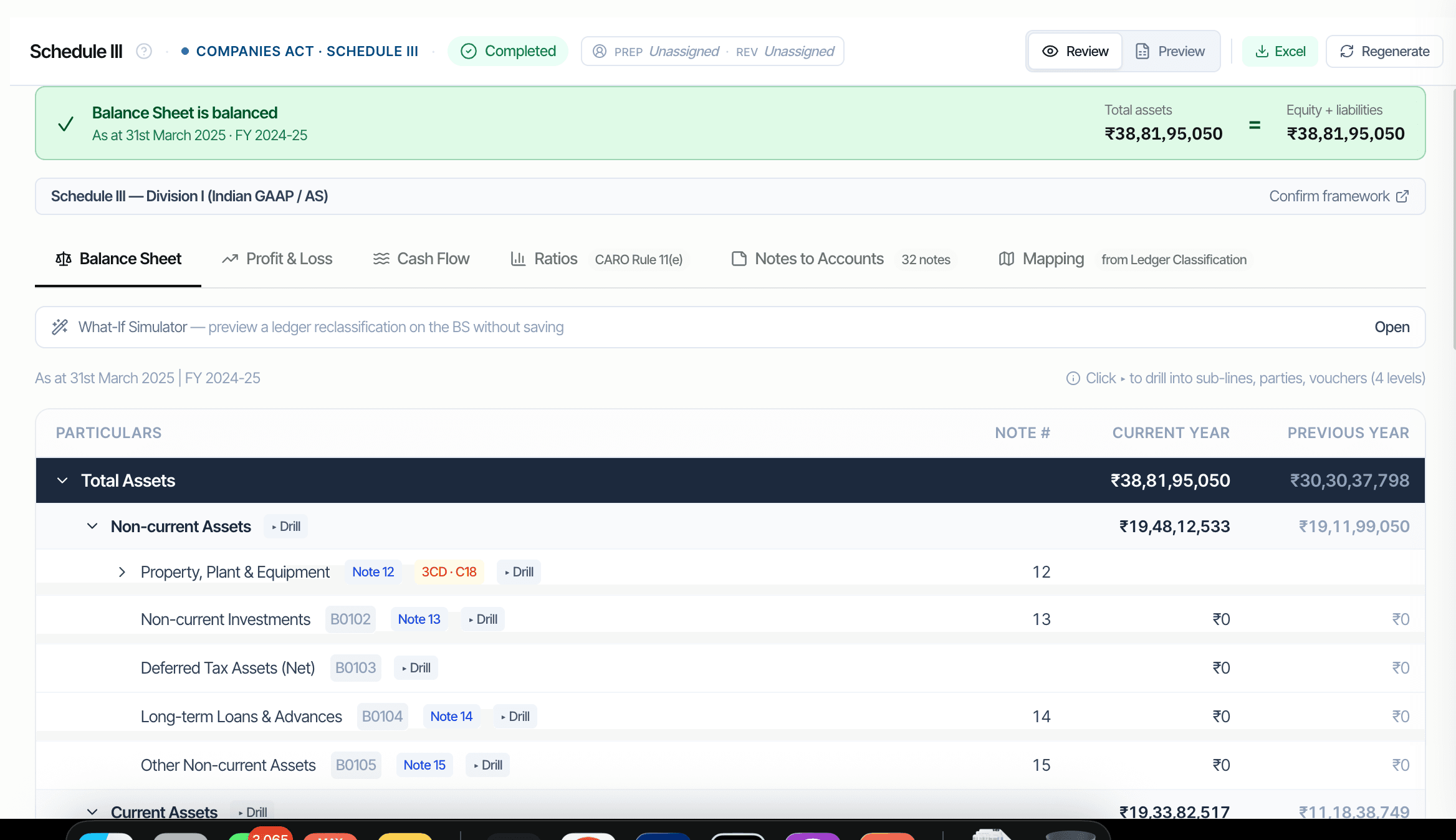
Each receivable falls into one of the five Sch III ತಿದ್ದುಪಡಿ 2021 buckets. The bucket totals roll up to the Trade Receivables line on the Balance Sheet. CY and PY ageing rendered ಅಕ್ಕಪಕ್ಕ.

Step 03

Cessation review

Receivables over 3 years are candidates for write-off under Section 41(1) of the ಆದಾಯ ತೆರಿಗೆ ಕಾಯ್ದೆ (cessation of liability, reverse for assets). The ಆಡಿಟರ್ reviews each, decides to provide or write off, and the disposition ಶುಲ್ಕds Form 3CD Clause 16.

Inside the module

What you actually get.

Schedule III ತಿದ್ದುಪಡಿ 2021 buckets

Five buckets exactly as mandated. The bucket boundaries are non-negotiable and CORAA's render matches the regulator's exact text.

  • Less than 6 months
  • 6 months to 1 year
  • 1 to 2 years
  • 2 to 3 years
  • Over 3 years

Secured / Unsecured / Doubtful split

Each bucket further splits by security: Secured (against assets, guarantees), Unsecured, and Doubtful (provision-eligible). The classification ಶುಲ್ಕds ಇಲ್ಲte 19 Trade Receivables.

  • Secured: party-level security flag
  • Unsecured: default for trade receivables
  • Doubtful: provision-eligible per AS 4
  • Total by classification on ಇಲ್ಲte 19

Section 41(1) cessation flagging

Receivables over 3 years prompt Sec 41(1) review. If the party has clearly ceased to exist or pay (winding up, NCLT order, prolonged absence), the receivable is written off; otherwise a provision is created.

  • Auto-flag for >3 year receivables
  • Cessation evidence capture
  • Write-off vs provision decision
  • ಶುಲ್ಕds Form 3CD Clause 16 disposition

Provision for doubtful debts

AS 4 prescribes a provision for doubtful debts based on the ಆಡಿಟರ್'s expectation of recoverability. CORAA suggests a provision based on ageing distribution; the ಆಡಿಟರ್ confirms or adjusts.

  • AS 4 provision logic
  • Ageing-based suggestion
  • ಆಡಿಟರ್ adjustment with rationale
  • Provision flows to ಇಲ್ಲte 19 and P&L
Frequently asked

Answers, up front.

Without the ಪಾರ್ಟಿ ಮಾಸ್ಟರ್, CORAA can still produce aggregate ageing buckets ಟಿಯರ್ I ನಲ್ಲಿ (because ವೌಚರ್‌ಗಳು carry dates regardless of party identity). The ಆಡಿಟರ್ sees totals per bucket but not the party-level breakdown. ಟಿಯರ್ II ಪಾರ್ಟಿಯನ್ನು ಅನ್‌ಲಾಕ್ ಮಾಡುತ್ತದೆ-wise distribution; ಟಿಯರ್ III unlocks bill-wise precision.
Two signals: (1) ಆಡಿಟರ್ manually flags the party as Doubtful in the ಪಾರ್ಟಿ ಮಾಸ್ಟರ್, or (2) CORAA's provision logic flags receivables that have crossed the 1-year boundary without payment activity. The ಆಡಿಟರ್ confirms before the classification locks.
ಹೌದು. CARO Rule 11(e) requires the Trade Receivable Turnover Ratio. CORAA computes it as Net Credit Sales divided by Average Trade Receivables; the figure flows to the Schedule III Ratios tab and to CARO 2020 Clause 3(xi)(e). Variances over 25% from PY require ಆಡಿಟರ್ explanation.
See it on a real ledger

Run ar ageing on one of your engagements.

Bring a Trial Balance and a General Ledger. We'll walk through working papers end-to-end on your data, not a sandbox.

Start the free trial →Book a walk-through
AR Ageing Audit Working Paper | Schedule III Buckets | CORAA | CORAA