CORAA
Working Papers

Working Papers

Working Papers are the auditor's evidence pack. Not the report sent to the client, the proof behind it.

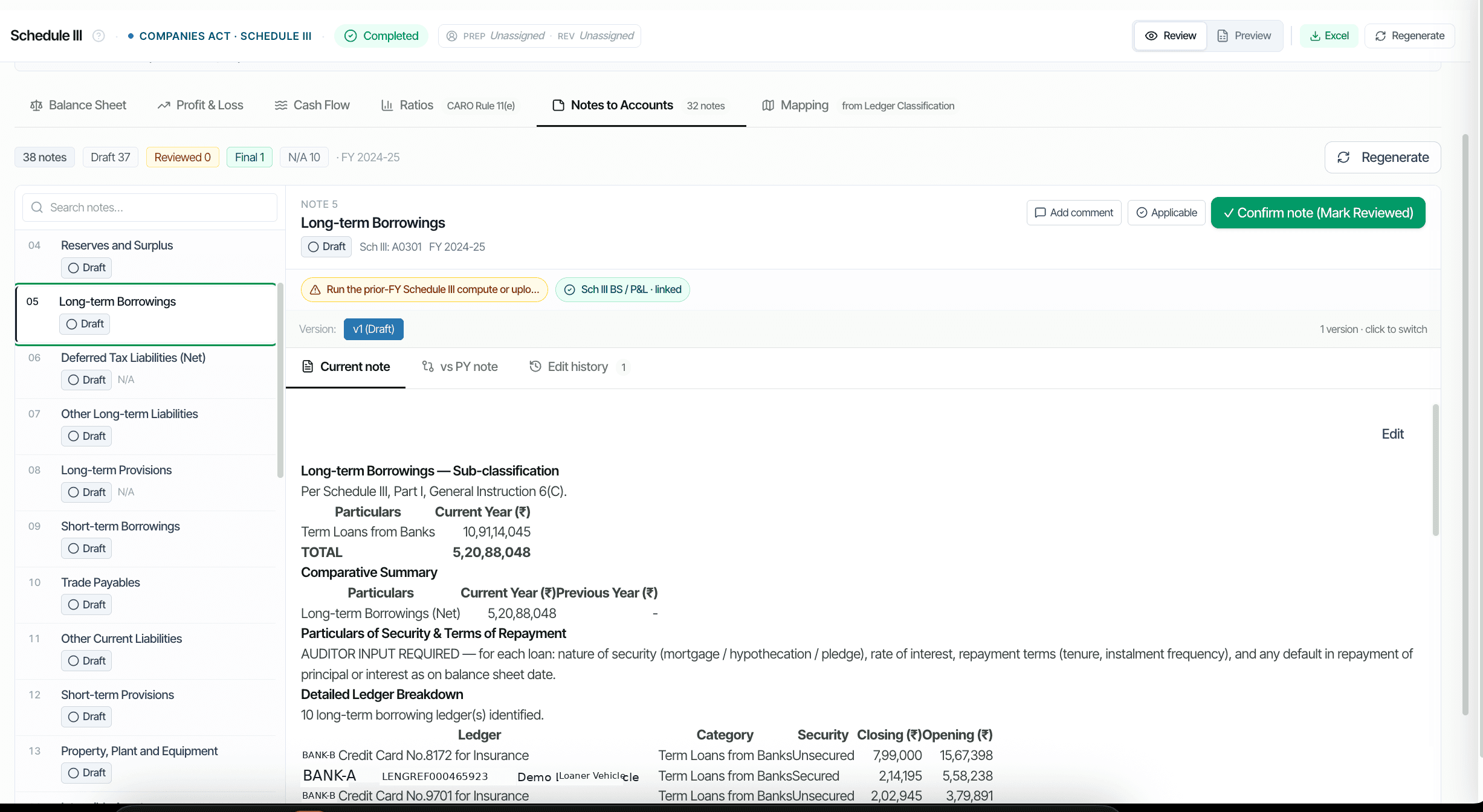
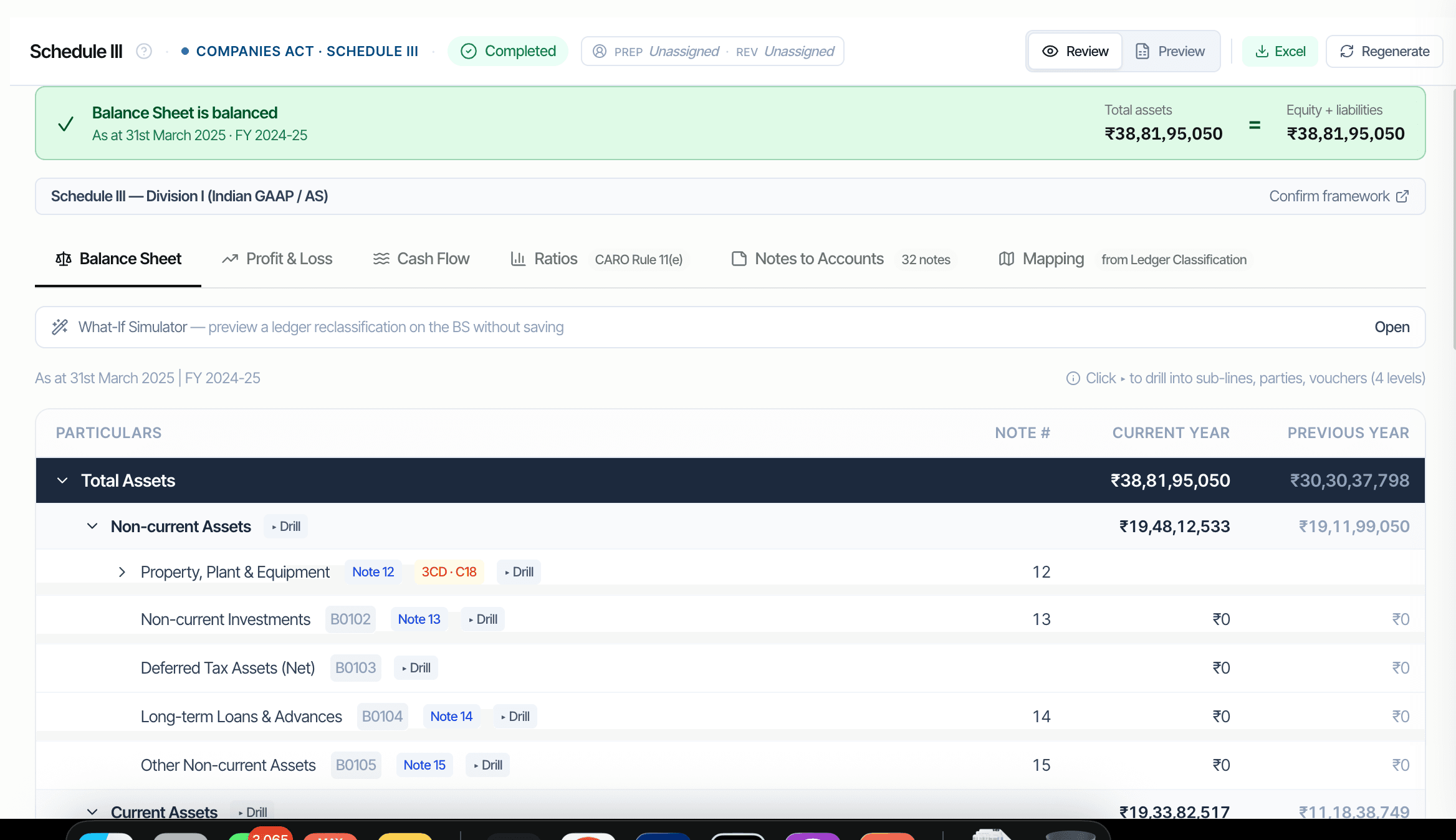
CORAA Schedule III Balance Sheet with three-level drill
01·Lead schedules

Three-level drill from balance head to voucher.

Lead schedules compose per Schedule III balance head from the mapped ledger data. Click any balance head to expand to its constituent ledgers; click any ledger to see the parties; click any party to see the source vouchers. Three levels deep, all live formulas, tie-out enforced at composition.

  • Per Schedule III balance head, Equity, Borrowings, Trade Payables, Receivables, etc.
  • Three-level drill: balance head → ledgers → parties → vouchers
  • CY and PY columns with variance highlight
  • Tie-out enforced at composition, Assets must equal Equity + Liabilities
  • Click to expand, click to drill, click to source

Reclassify a ledger in Ledger Mapping, every dependent Working Paper recomposes automatically.

Notes to Accounts with party-level ageing breakdown
02·Sch III amendment 2021

Trade receivables and payables ageing, bucket by bucket.

The Sch III amendment 2021 mandates specific ageing buckets, under 6 months, 6 months to 1 year, 1-2 years, 2-3 years, and over 3 years. CORAA composes the buckets automatically with Secured / Unsecured / Doubtful splits for receivables and MSME / non-MSME splits for payables per the MSMED Act 2006.

  • Receivables ageing buckets per Sch III amendment 2021
  • Secured / Unsecured / Doubtful split for receivables
  • MSME / non-MSME split for payables per MSMED Act 2006
  • Section 41(1) cessation candidates flagged for over-3-year payables
  • Section 15 MSMED interest disclosure

Party-wise ageing once the Party Master is loaded. Bill-wise precision once the Bill Register arrives.

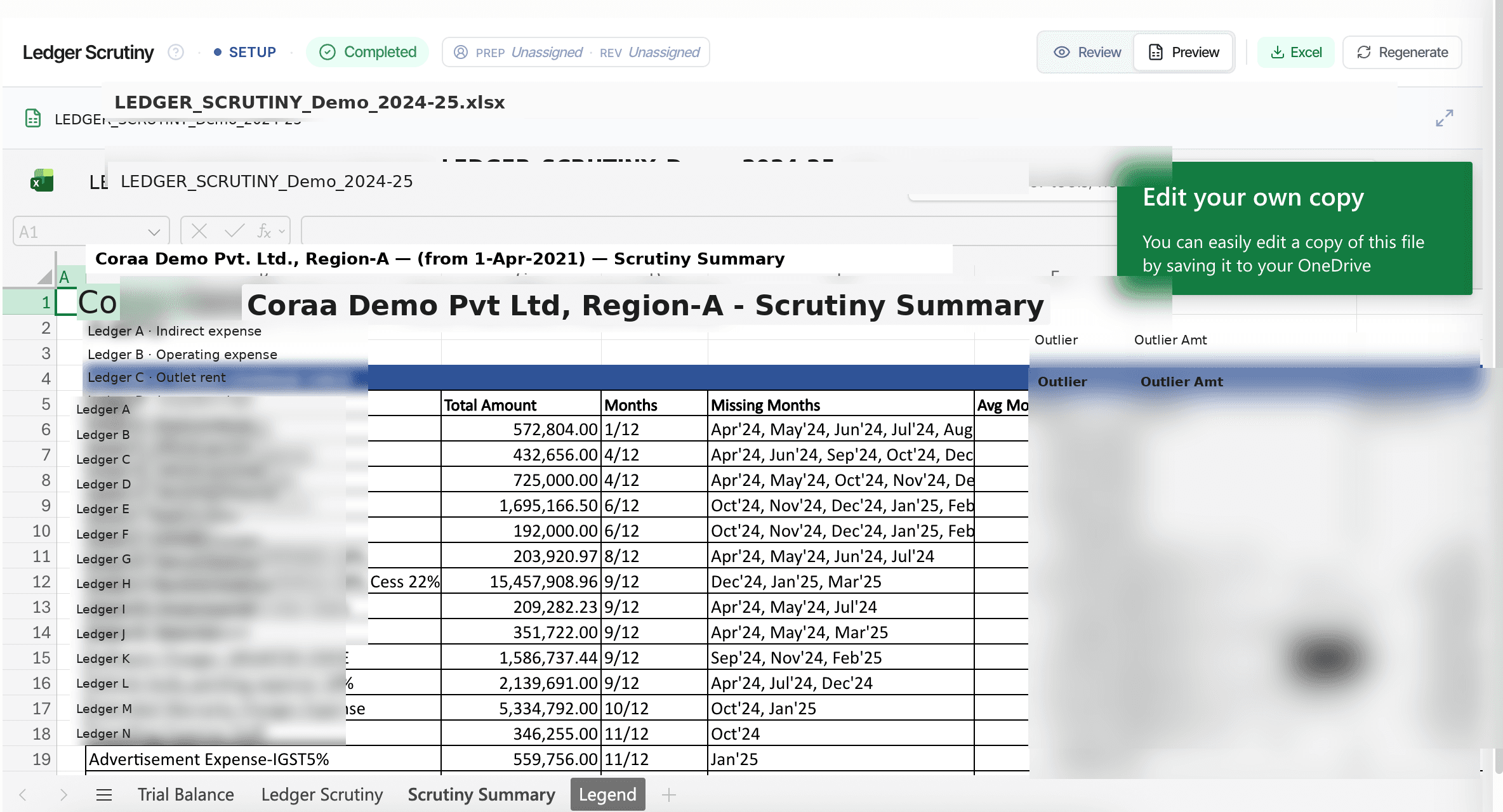
CORAA Working Paper exported to firm's Excel template
03·Sch II · Sec 32

Fixed asset roll-forward by class.

PPE roll-forward composes per asset class from the Fixed Asset Register, Gross Block, Additions, Disposals, Depreciation Charge, Depreciation Reversed, Net Block. Schedule II useful-life check runs against declared depreciation method. Section 32 depreciation for tax audit composes alongside.

  • Block-wise roll-forward by asset class, Buildings, P&M, Furniture, Vehicles, IT
  • Schedule II useful-life verification against declared method
  • Section 32 depreciation for tax audit composed alongside Schedule II
  • Put-to-use date logic for mid-year additions, half-rate for under 180 days
  • Impairment triggers flagged when disposals at loss
Working Paper composed in Schedule III shape, exportable to Excel
04·Your firm's templates

Excel exports in your firm's shape, not ours.

Working Papers export to standard Excel, saved to your firm's OneDrive, in your firm's templates. Drop your lead schedule template once; CORAA fills it on every engagement going forward. No proprietary CORAA format, no template lock-in, no exit cost.

  • Standard Excel output, no CORAA-only format
  • Save to OneDrive, SharePoint, or local drive
  • Drop your firm's lead schedule template once; reused thereafter
  • AR/AP ageing, FA roll-forward, cash flow, each templatable per firm
  • Export to PDF for client delivery or filing

No forced formats. No template lock-in. Your firm's evidence, your firm's shape.

Inside Working Papers

Inside Working Papers

Nineteen evidence workbooks, composed from the mapped ledger data, exported to your firm's templates.

Module
Lead Schedules
Per Schedule III balance head with three-level drill from line to ledgers to parties to vouchers.
Read more →
Sch II
Fixed Assets / PPE
Block-wise roll-forward by class. Schedule II useful-life check. Section 32 for tax audit.
Read more →
AS 3
Cash Flow Workings
Indirect method from BS movement and P&L non-cash adjustments. Reconciles to Cash and Bank closing balance.
Read more →
SA 505
Trade Receivables
The full receivables caption paper. Dual bill-date ageing, party-wise summary, undated-bill flags, SA 505 cited, six-lens reviewed.
Read more →
43B(h)
Trade Payables
Dual ageing plus the MSME triple-feed: Section 15 interest, Section 16 to Form 3CD Clause 22, Section 43B(h) disallowance, split out.
Read more →
SA 550
Related Parties
SA 550, register-first. Empty register is a HIGH finding. Candidates surfaced for the auditor to confirm, never auto-asserted.
Read more →
CARO 3(iii)
Loans & Advances
Asset-vs-Liability composition buckets, a signed-movement check for genuinely static accounts, and CARO 3(iii)/Sec 185/186 flags with an honest disablement when there's no RP register.
Read more →
SA 505
Cash & Bank
Per-ledger movement tie-off, control reconciliation with sign-anomaly flags, dormancy detection, and an SA 505 confirmations tracker that keeps dormant accounts visible.
Read more →
SA 501
Inventory
Ledger-sourced closing stock, GP% trend with a written conclusion, per-item price exceptions, quantity-coverage, and an honest Type B nil when there's nothing to test.
Read more →
SA 505/540
Investments
Type A nil vs Type B present, decided by one rule printed on the page. Sub-type read structurally from the parent group. Valuation left to the auditor.
Read more →
Sch III
Capital & Reserves
SOCIE-style movement bridge, appropriation-flag check, and an honest FLAG when ΔP&L doesn't reconcile to net profit. Framework-aware for company vs LLP.
Read more →
SA 501
Borrowings
Secured/Unsecured/Long-term/Overdraft schedule with lender-level reconciliation and a shared interest-rate bridge that ties to Finance Cost by construction.
Read more →
Sch III
Profit & Loss Captions
One audit-first service stamps all five P&L captions. Final-week cut-off scan, Finance-Cost-to-Borrowings bridge, Other Expenses from TDS-section stamps.
Read more →
SA 450
Misstatements Summary
The SA 450 findings terminus. Every finding across every working paper aggregated into one formula-chained Excel export.
Read more →
SA 520
Overall Analytical Review
SA 520 trends and ratios, plus a cross-statement consistency engine, Revenue vs Receivables, implied cost of debt vs Borrowings.
Read more →
SA 220
EQR Readiness Cockpit
A hard 'Ready for Opinion' gate that names its specific blockers. Sits alongside the SQM 1 / SQC 1 quality-management workbook.
Read more →
SA 315
Audit Planning Summary
A deterministic fact-pack from the trial balance. YoY changes with honest basis labels, rule-based focus areas, evidence-cited management questions.
Read more →
Sch III
Schedule III Disclosure Review
A groups, hero, and blockers view across every Schedule III disclosure requirement, missing ones surfaced before the filing deadline.
Read more →
SA 230
SA 230 Audit Documentation
Every procedure timestamped, every selection seed-printed, every conclusion linked to evidence — re-performable by an experienced auditor with no prior knowledge.
Read more →
Frequently asked

Answers, up front.

Working Papers are the audit firm's reference workbooks, lead schedules, ageing breakdowns, fixed-asset roll-forwards. They prove the figures. Reporting is what gets filed externally, Schedule III, Form 3CD, CARO 2020, the Auditor's Report. Working Papers stay with the firm's audit file; Reporting goes to the client, ROC, and the Income Tax department.
Yes. The firm uploads its lead schedule, ageing, and roll-forward templates once. CORAA fills them on every subsequent engagement. Output is standard Excel, saved to OneDrive, SharePoint, or local drive. No proprietary format.
Lead schedules and cash flow workings are available immediately, both compose from BS and P&L movement alone. Party-wise AR/AP ageing becomes available once the Party Master is loaded. Bill-wise ageing and the PPE roll-forward by class become available once the Bill Register and Fixed Asset Register arrive.
Yes. Lead schedules, ageing analyses, and roll-forwards compose from live formulas against the mapped ledger data. Reclassifying a ledger in Ledger Mapping triggers automatic recomputation across every dependent Working Paper. The recompute event is captured in the audit trail per SA 230.
Take it for a spin

Run a live audit. See the working.

Connect one client. Walk through the full audit lifecycle, classification through UDIN sign-off. No decks masquerading as demos.

Run your first audit free →
Audit Working Papers, Lead Schedules, Ageing, FA Roll-forward | CORAA