CORAA
Procedures· विधि

Procedures

When a peer reviewer asks why the sample size is 62, or why the benchmark is PBT rather than turnover, the auditor needs a defensible answer. Every working shown.

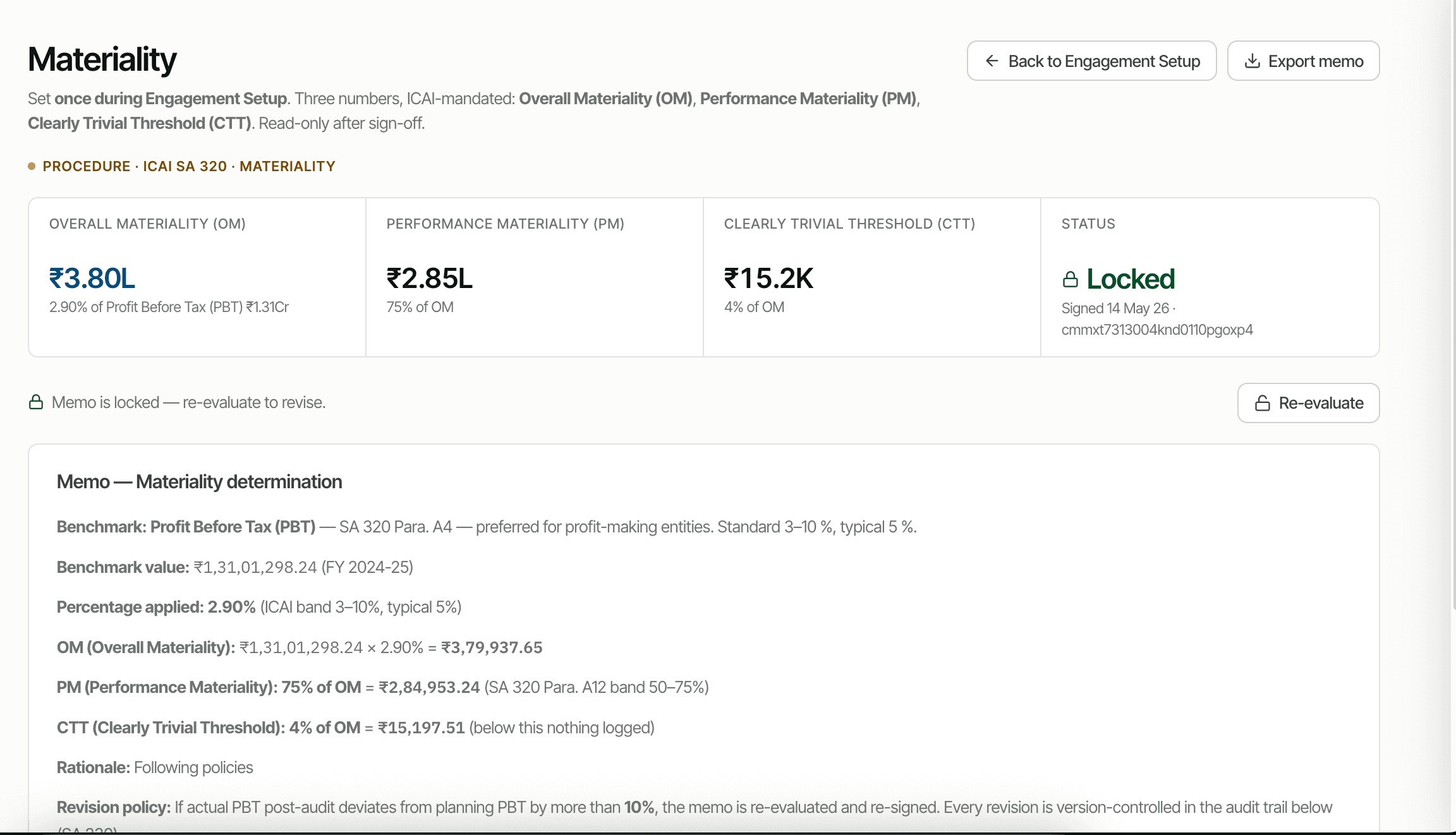
CORAA Materiality memo locked under SA 320
01·SA 320

Materiality, locked before fieldwork.

SA 320 mandates that materiality be set before fieldwork begins, documented with rationale, and locked. A three-step wizard guides the benchmark choice, PBT, Turnover, or Equity, applies the percentage within the ICAI 3-10 percent band, derives Performance Materiality and Clearly Trivial Threshold, and locks the memo. Out-of-band percentages require written rationale captured in the audit trail per SA 230.

  • Step 1, pick benchmark: PBT, Turnover, or Equity
  • Step 2, pick percentage with the ICAI 3-10% band rendered
  • Step 3, derive PM (50-75% of OM) and CTT (typically 5% of OM)
  • Off-band selections require written rationale logged to audit trail
  • Locked memo consumed by Sampling, Findings, and Opinion

Revision triggers a documented re-evaluation note per SA 230. The original and revised memo are both preserved.

CORAA Sampling, per-Working-Paper plans with SA 530 formula
02·SA 530

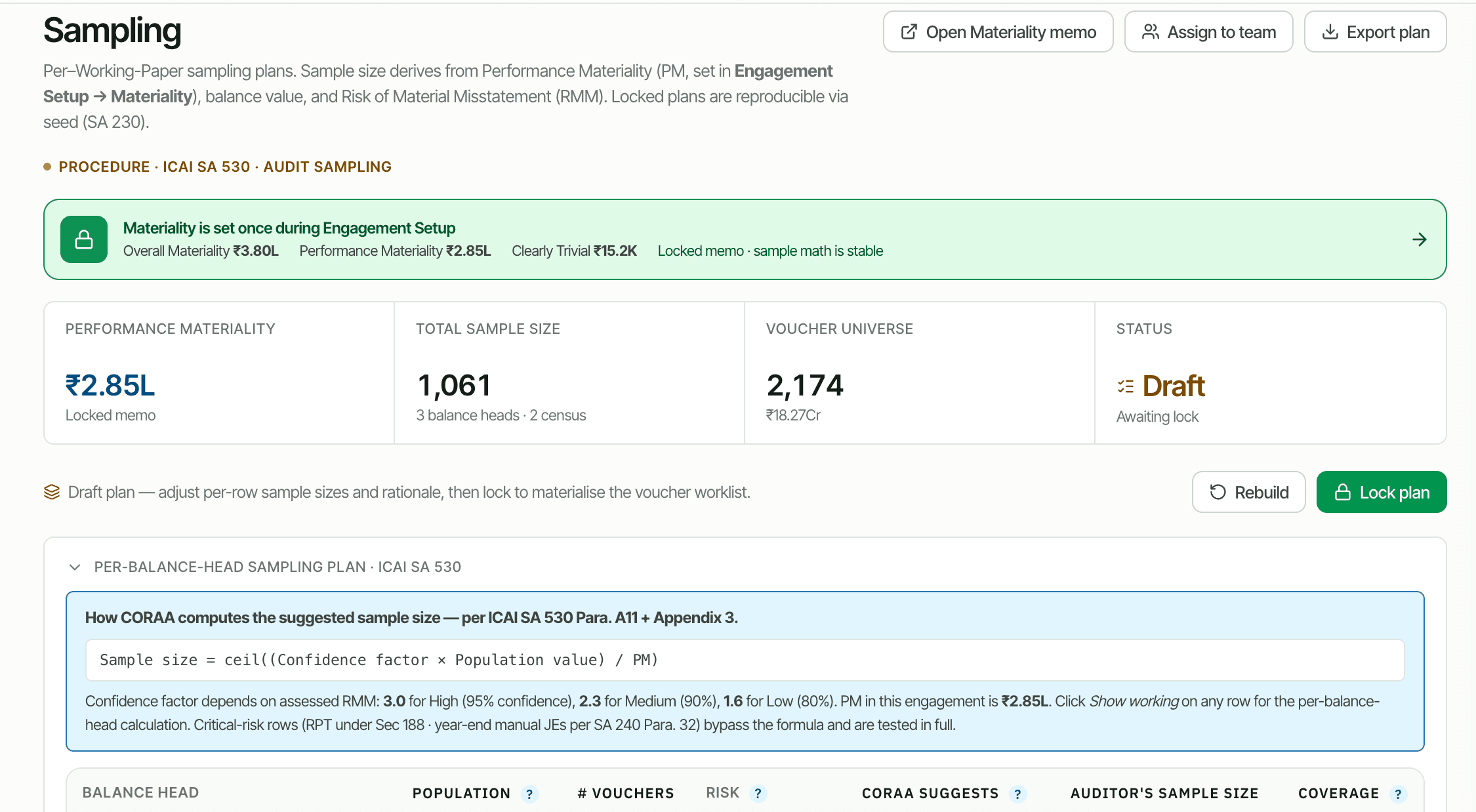
Sampling, the formula, not the answer.

Sample size equals the ceiling of confidence factor times population value divided by Performance Materiality. Confidence factors come from the Poisson distribution, 3.0 for 95 percent confidence, 2.3 for 90 percent, 1.6 for 80 percent. The math is rendered on every Working Paper. Auditors defend the number; CORAA shows the working.

  • Formula ceil((CF × Population value) / PM) rendered on every plan
  • Confidence factors visible, 3.0 / 2.3 / 1.6 mapped to high/medium/low risk
  • Worked example: Trade Payables ₹5 Cr × CF 3.0 / PM ₹35.8 L = 42 vouchers
  • Force-census rows for 100% testing, year-end JEs, RPT, employee benefits
  • MUS for high-value populations; simple random otherwise

Auditor sees the calculation, not a black box.

CORAA Sampling, lock plan generates deterministic voucher selection
03·SA 230

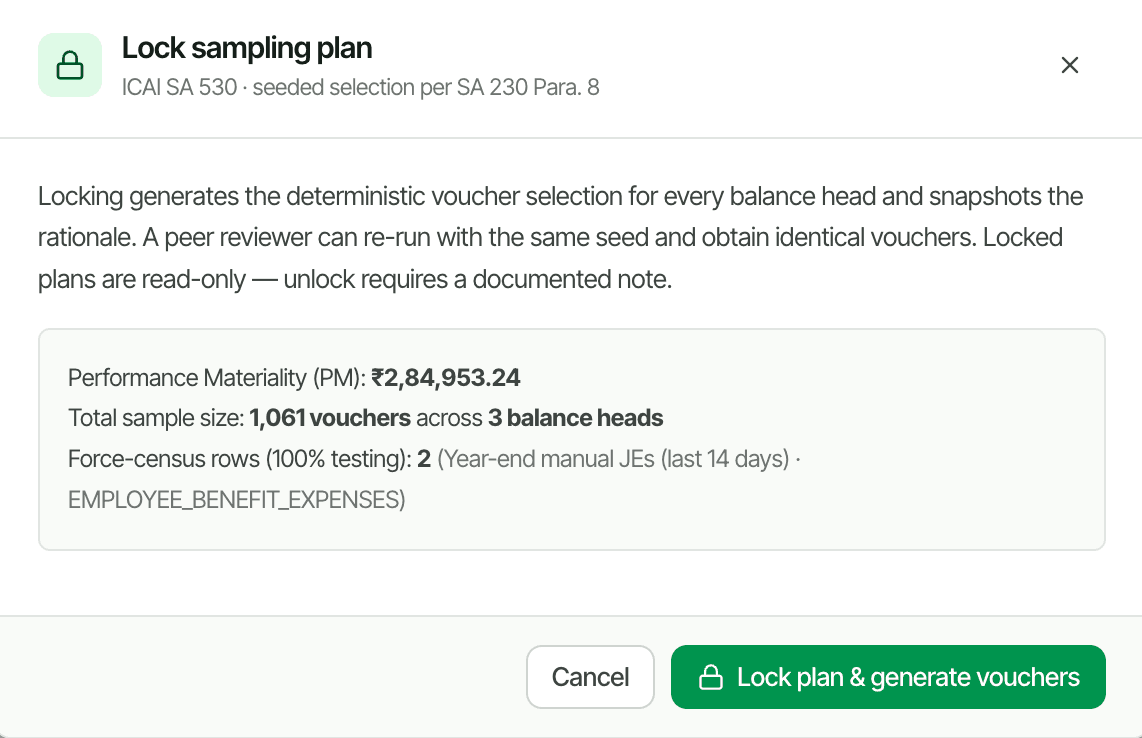
Reproducible. Defensible. Peer-review ready.

Each random selection is seeded with a deterministic value derived from the engagement ID and balance head code, hashed via SHA-256 and pinned to a specific numpy version. A peer reviewer running the same seed obtains the same vouchers. SA 230 Para. 8 reproducibility satisfied; NFRA inspection ready.

  • Seeded selection per SA 230 Para. 8
  • SHA-256 hash and numpy version pinned for cross-year reproducibility
  • Seed rendered explicitly on every Working Paper
  • Locked plans read-only, unlock requires documented note
  • Force-census rows configurable per engagement
CORAA Going Concern Assessment with 16 indicators
04·SA 570

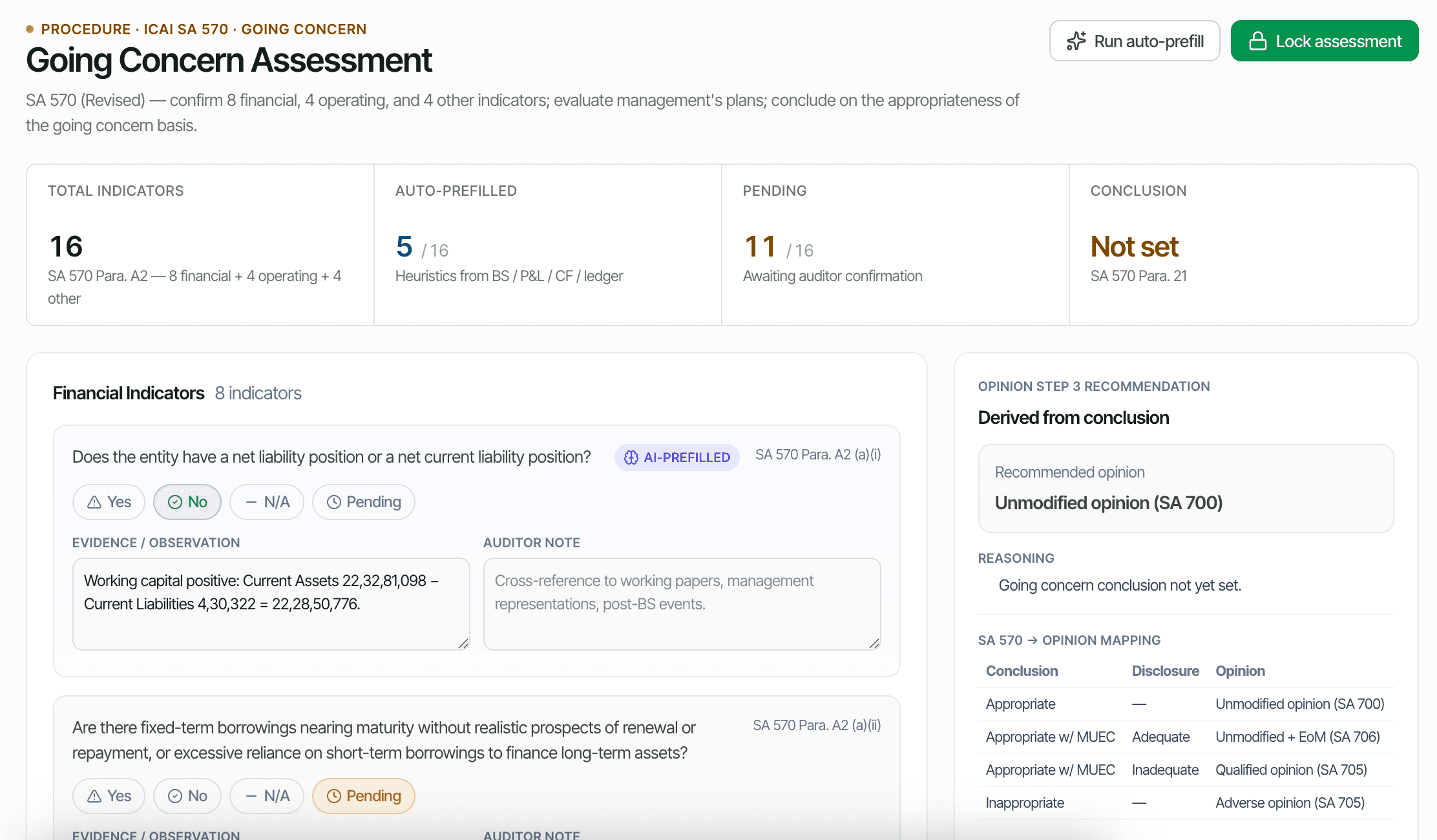
Going Concern, with the financial work done.

SA 570 (Revised) requires evaluation of 16 indicators across financial, operating, and other categories. CORAA pre-fills the eight financial indicators from Balance Sheet, P&L, and Cash Flow data, working capital position, debt-service coverage, current ratio trend, net liability detection. The auditor provides the operating and other inputs with notes.

  • 16 indicators per SA 570 (Revised), financial 8, operating 4, other 4
  • Financial 8 auto-prefilled from BS / P&L / Cash Flow data
  • Operating and other indicators captured with Yes/No/N/A and notes
  • Each indicator anchored to its SA 570 paragraph reference
  • Conclusion drives Opinion type per the SA 570 → SA 700 mapping
Inside Procedures

Inside Procedures

Four ICAI-mandated procedures with the work shown, auditor defensible, peer-review reproducible.

Frequently asked

Answers, up front.

SA 320 requires materiality to be set before fieldwork begins. Once sampling, findings classification, and Opinion sign-off rely on the number, it cannot quietly change. Revision requires a documented re-evaluation note per SA 230. The locked memo is what makes the working paper defensible under NFRA inspection or peer review.
Per ICAI SA 530 Para A11 and Appendix 3: sample size equals ceiling of (Confidence factor × Population value) divided by Performance Materiality. Confidence factors derive from the Poisson distribution, 3.0 for 95% confidence, 2.3 for 90%, 1.6 for 80%. Worked example: Trade Payables population ₹5 crore, PM ₹35.8 lakh, high risk = ceil((3.0 × 5,00,00,000) / 35,80,000) = 42 vouchers.
Each random selection is seeded with a deterministic value derived from the engagement ID and balance head code, hashed via SHA-256 and pinned to a specific numpy version. A peer reviewer running the same seed obtains the same vouchers. SA 230 Para. 8 reproducibility satisfied.
The eight financial indicators auto-populate from Balance Sheet, P&L, and Cash Flow data, working capital position, debt-service coverage, current ratio trend, net liability detection. The four operating and four other indicators require auditor judgment and are confirmed Yes/No/N/A with notes.
Take it for a spin

Run a live audit. See the working.

Connect one client. Walk through the full audit lifecycle, classification through UDIN sign-off. No decks masquerading as demos.

Start the free trial →Book a walk-through
Materiality, Sampling, Going Concern & Opening Balance | CORAA | CORAA