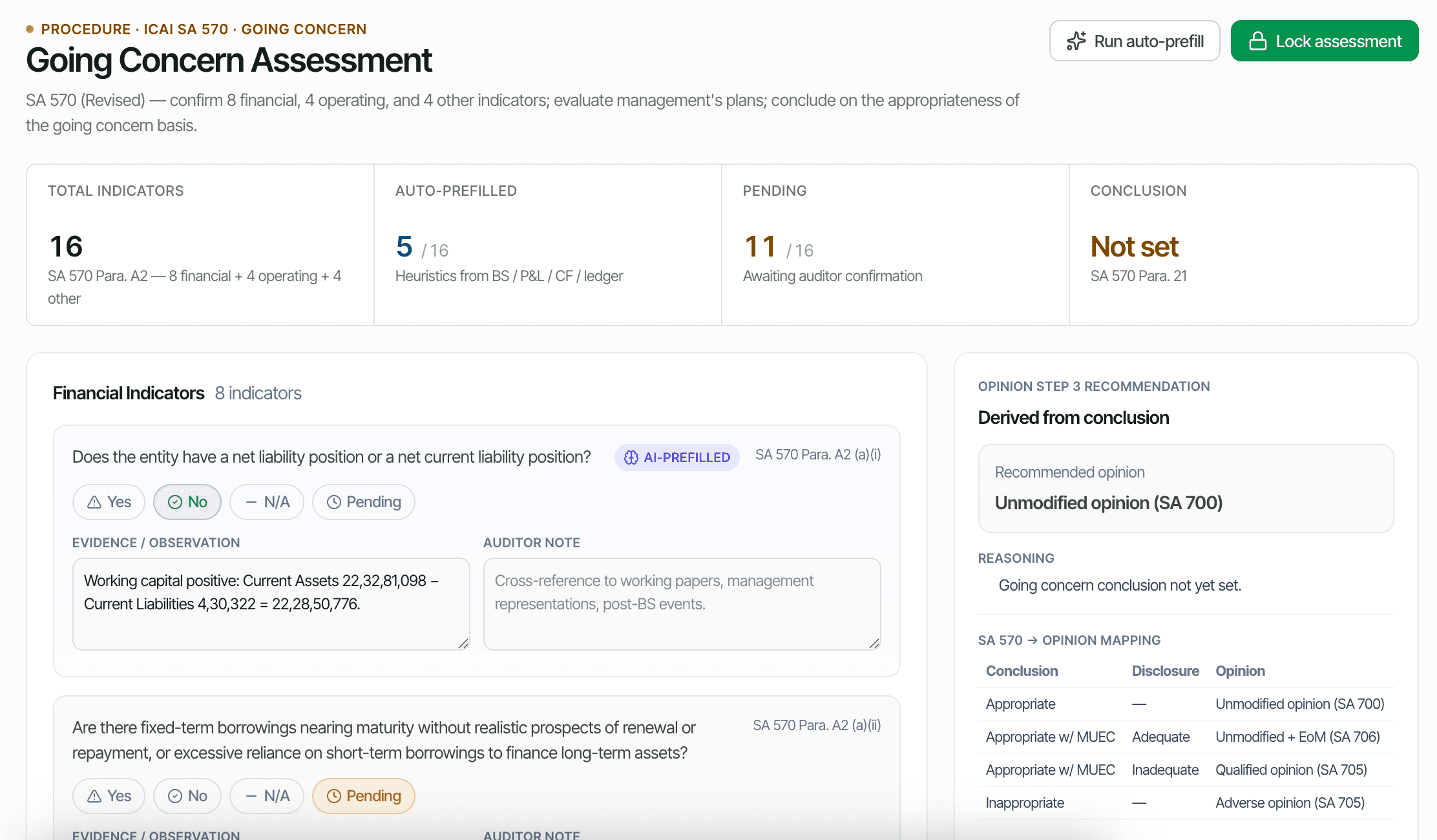
SA 570 (Revised) requires the auditor to evaluate 16 indicators across financial, operating, and other categories before concluding on the going concern basis. CORAA pre-fills five of the eight financial indicators straight from Balance Sheet, P&L, and Cash Flow data — each tagged AI-prefilled with its evidence line. The remaining indicators (including borrowings near maturity and withdrawal of lender support, which no ledger can answer) take the auditor's Yes/No/N/A with notes. The final conclusion drives the Opinion type per the SA 570 → SA 700 mapping table.
Two paths to the same audit conclusion. One leaves traces; the other doesn't.
CORAA reads BS, P&L, and Cash Flow to compute the five financial indicators with an unambiguous arithmetic signal — net current liability / net liability position, negative operating cash flow, adverse key ratios, substantial operating losses, and dividend arrears. Each shows the evidence inline (the computation, the underlying ledgers), and re-running never overwrites a row the auditor has touched.
The four operating indicators (loss of key customer, supply chain disruption, employee unrest, technology obsolescence) and four other indicators (pending litigation, regulatory action, breach of covenant, parent support uncertainty) require auditor judgment. Yes/No/N/A with notes.
Based on the 16 indicators, the auditor concludes, Going Concern Appropriate, Going Concern Appropriate with MUEC (Material Uncertainty Existing), or Going Concern Inappropriate. The conclusion drives the Opinion type via the SA 570 → SA 700 mapping table.
CORAA computes and pre-fills five financial indicators from BS, P&L, and Cash Flow. Each indicator shows the underlying evidence, the formula, the source ledgers, the numerical result. The auditor confirms or overrides with notes — touching a prefilled row makes it the auditor's answer.
The other eleven indicators require auditor judgment — including two financial ones (borrowings near maturity, withdrawal of creditor support) plus the operating and other categories. CORAA captures Yes/No/N/A with notes. Common indicators include loss of major customer, supply chain disruption, regulatory action, pending litigation with material impact, and parent-company support uncertainty.
The Going Concern conclusion directly drives the Opinion type. Going Concern Appropriate w/o MUEC → Unmodified. With MUEC → Unmodified with Emphasis of Matter (SA 706). Inappropriate use of Going Concern basis → Adverse Opinion. Disagreement on whether MUEC exists → Qualified.
Every indicator is paragraph-anchored to SA 570 (Revised). Every conclusion is evidence-backed. The Going Concern memo is locked at sign-off; revision requires a documented note per SA 230. NFRA-inspection ready.
The Altman Z-double-prime — the emerging-markets, book-equity variant, so it's derivable from the trial balance for unlisted Indian companies — plots Safe / Grey / Distress alongside the SA 570 indicators as one corroborating anchor. It never overrides the panel: SA 570 doesn't require an Altman score, so a Distress reading is something the auditor reconciles and documents, not a contradiction left sitting in the file. The same financial-ratio and ageing evidence also feeds CARO clause 3(xix), so the going-concern conclusion and the CARO comment are drawn from one consistent base.