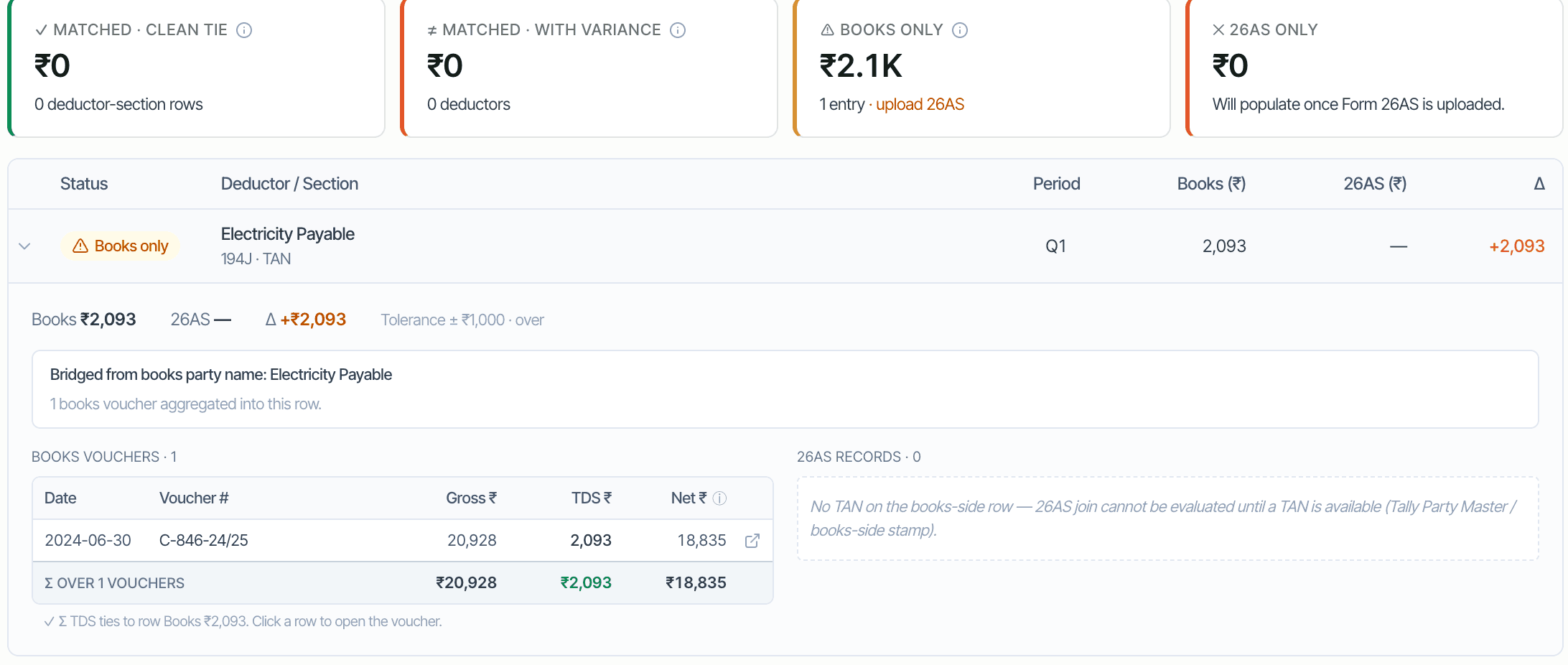
TDS verification runs in both directions. The Deductee · 26AS side reconciles the TDS credits in the books against Form 26AS, AIS and TRACES downloads — CORAA merges them, ties them to the TDS ledgers, and sorts every credit into matched, variance, books-only and 26AS-only, with potential Sec 199 recovery quantified. The Deductor · 26Q side totals the TDS the client itself deducted, section by section, and feeds Form 3CD Clause 34 directly. Threshold compliance verified per Income Tax Act section.
Two paths to the same audit conclusion. One leaves traces; the other doesn't.
Multi-file upload supports the full year, quarterly 26AS PDFs from TRACES, AIS JSON exports, and per-quarter downloads. CORAA merges them into one canonical record.
On the deductee side, books TDS ledgers (already loaded via ERP ingest) tie to 26AS deductor entries: matched, variance, books-only, 26AS-only — with 26AS-only credits tested as potential Sec 199 recovery. On the deductor side, books deductions total section by section.
Open any variance to see the source voucher, the cause, and the disclosure path. Deductor-side section totals feed Form 3CD Clause 34(a) directly; variances above tolerance disclose at Clause 34(b).
Every TDS entry lands in matched, books-only, or 26AS-only. The bucket totals reveal where the reconciliation effort is needed.
Clause 34(a) of Form 3CD requires section-wise TDS totals, Sec 192 salary, 194A interest, 194C contractor, 194I rent, 194JB professional, 194Q goods, 194R perquisites. CORAA computes these from the deductor-side books data — the deducted-on-payments direction, distinct from the 26AS credits — and previews the Clause 34 tables.
Each IT Act section has its own threshold, Sec 194A ₹40,000 for banks, 194C ₹30,000 single / ₹1L aggregate, 194I ₹2.4L for rent. CORAA verifies threshold compliance per vendor per section.
TRACES exports come quarterly. AIS comes annually. Clients often share fragments mid-engagement. CORAA accepts every format and version, merges them, and supersedes older files automatically.
A potential Sec 199 credit is flagged as recoverable only where the corresponding income is offered to tax, per Rule 37BA, and where the return is still within the revision window under Sec 139(5); lines that are time-barred, belong to another year or assessee, or are timing differences are held back rather than counted. For TAN-less ERP entries, name-bridging reconciles the party against the 26AS deductor so a missing TAN doesn't drop the credit, and low-confidence matches are routed to their own review bucket instead of being asserted.