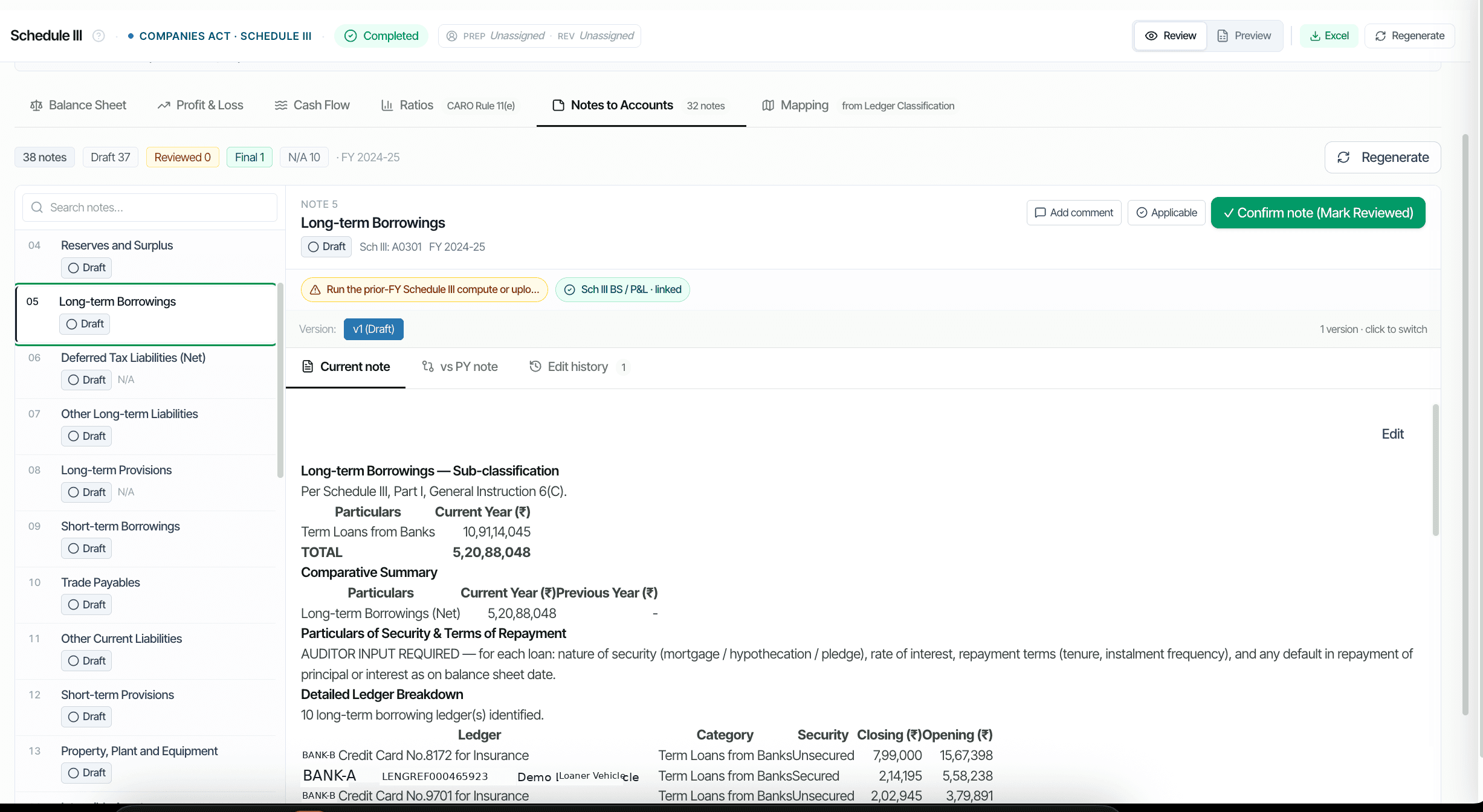
A missing Schedule III note is usually found during final review, days before filing, when there is little time left to fix it. CORAA's Disclosure Review walks every Schedule III disclosure requirement against the engagement's own data and presents it as a groups, hero, and blockers view, the disclosure groups the requirement falls under, the headline status for the statement as a whole, and the specific blockers still outstanding, so a missing disclosure surfaces the moment the data behind it exists, not the week the filing is due.
Two paths to the same audit conclusion. One leaves traces; the other doesn't.
CORAA holds the full set of Schedule III disclosure requirements and checks each one against what the engagement's working papers and Sch III report actually contain, rather than relying on a reviewer's memory of what was covered last year.
Requirements are organised by disclosure group, a hero status gives the headline picture for the statement as a whole, and a blockers list names each requirement that is not yet met, so the reviewer sees both the overview and the specifics in one place.
Because the review runs continuously against the current state of the engagement, a disclosure gap is visible as soon as it exists, well before the final-review week when there is little time left to close it.
Every disclosure requirement under Schedule III is checked against the engagement's own data, not a static checklist carried forward from last year.
Disclosure requirements are organised by group, with a hero status giving the headline picture of overall disclosure completeness.
Every missing disclosure is listed as a specific, named blocker rather than a generic incomplete flag.
Because the review runs continuously, gaps are visible well before the final-review week rather than being discovered against a filing deadline.