CORAA
AI Modules/Working Papers/Cash & Bank
SA 505 · Cash & Bank· पत्र

Cash & Bank

Per-ledger movement tie-off, control-account reconciliation with sign-anomaly flags, dormancy detection, and an SA 505 confirmations tracker that keeps dormant accounts visible instead of letting them drop off.

CORAA ledger scrutiny interface with voucher-level drill for bank ledgers

Cash & Bank ties every ledger's movement before it reports anything else: Opening plus Debit plus Credit minus Closing must equal zero for each cash and bank ledger, so any break in the arithmetic surfaces immediately rather than netting away in a control total. Control accounts are reconciled against the underlying ledgers, and a sign-anomaly flag catches accounts sitting on the wrong side, a bank account in credit that should be in debit, for instance. Ledgers with no activity across the year are flagged as dormant. Sitting alongside the movement and reconciliation work is an SA 505 confirmations tracker built as resolution-bridge rows: every confirmation request carries a status that has to resolve, not a checkbox that can be ticked and forgotten. Dormant and zero-balance accounts stay visible on that tracker rather than dropping off the list, because that is exactly where window-dressing hides, and the same accounts feed the going-concern read.

  • Per-ledger movement tie-off: Opening + Debit + Credit − Closing must equal zero, or the break surfaces immediately
  • Control-account reconciliation against the underlying cash/bank ledgers
  • Sign-anomaly flags, a bank account sitting in credit that should be in debit, for example
  • Dormancy detection for ledgers with zero activity across the year
  • SA 505 confirmations tracker as resolution-bridge rows, each request's status has to resolve, not just get ticked
  • Dormant and zero-balance accounts persist on the tracker and feed the going-concern read, they don't quietly drop off
Two paths, one ledger

The old way, and ours.

Two paths to the same audit conclusion. One leaves traces; the other doesn't.

Traditional

The old way

  • -Movement tie-off done manually per ledger, easy to miss a small break that a total-level check would hide
  • -Sign anomalies, a bank account in credit, a cash ledger in credit, caught only if someone happens to scan the trial balance closely
  • -Dormant accounts often drop off the working paper once a confirmation is requested, whether or not it's ever resolved
  • -Confirmation tracking kept as a simple checklist, hard to tell a resolved confirmation from one still outstanding
Build time: a full day reconciling controls and chasing confirmations by hand. Dormant accounts are exactly where window-dressing hides, and they're the first thing a checklist loses track of.
CORAA

On the Ledger

  • Every cash/bank ledger's movement tied off automatically, breaks surface at the ledger, not buried in a control total
  • Sign-anomaly flags computed across every ledger, not just the ones someone happens to scan
  • Dormant and zero-activity ledgers flagged and kept visible, never dropped once flagged
  • SA 505 confirmations tracked as resolution-bridge rows, each with a status that must resolve
  • Going-concern hooks read the same dormancy and confirmation data, no separate re-entry
Build time: instant. Nothing dormant, and nothing unresolved, quietly disappears from the tracker.
How it works

Three steps. Every trace logged.

Step 01

Per-ledger movement tie-off

For every cash and bank ledger, Opening plus Debit plus Credit minus Closing is computed and must equal zero. Any ledger where the arithmetic doesn't tie is surfaced immediately as its own exception, before the working paper looks at anything else.

Step 02

Control reconciliation and sign anomalies

Control accounts are reconciled against the ledgers feeding them, and every ledger is checked for a sign anomaly, a bank account sitting in credit when it should be in debit is a common example, flagged as its own exception rather than netted quietly into the balance.

Step 03

Dormancy and the SA 505 resolution bridge

Ledgers with no activity across the year are flagged as dormant. Every SA 505 confirmation request is tracked as a resolution-bridge row with a status that has to resolve, and dormant or zero-balance accounts stay visible on that tracker rather than dropping off, feeding the going-concern read alongside it.

Inside the module

What you actually get.

Movement tie-off, per ledger

Opening + Debit + Credit − Closing is checked for every individual cash and bank ledger, not just at the control-account level, so a break surfaces at the ledger where it happened.

  • Opening + Debit + Credit − Closing = 0, per ledger
  • Any break flagged as its own exception, immediately
  • Runs across every cash and bank ledger, not a sample
  • CY and PY movement shown side by side

Control reconciliation and sign-anomaly flags

Control totals are reconciled against the underlying ledgers, and every ledger is checked for sitting on the wrong side, a credit balance in an account that should carry a debit, for instance.

  • Control-account reconciliation against ledger detail
  • Sign-anomaly flag: wrong-side balances surfaced, not netted away
  • Dormancy flag for ledgers with zero activity across the year
  • All flags carried into the working paper's own exceptions section

SA 505 confirmations, resolution-bridge rows

Every confirmation request is a row with a status that must resolve, sent, received, matched, or exception, not a one-time checkbox, so the tracker shows exactly what's still open.

  • Each confirmation request tracked as its own resolution-bridge row
  • Status must resolve, it isn't a static checkbox
  • Cited to SA 505 for external confirmation procedure
  • Full history retained for the reviewer

Dormant accounts stay visible

Zero-activity and dormant accounts persist on the confirmations tracker and feed the going-concern hooks rather than dropping off once flagged, because that is exactly where window-dressing hides.

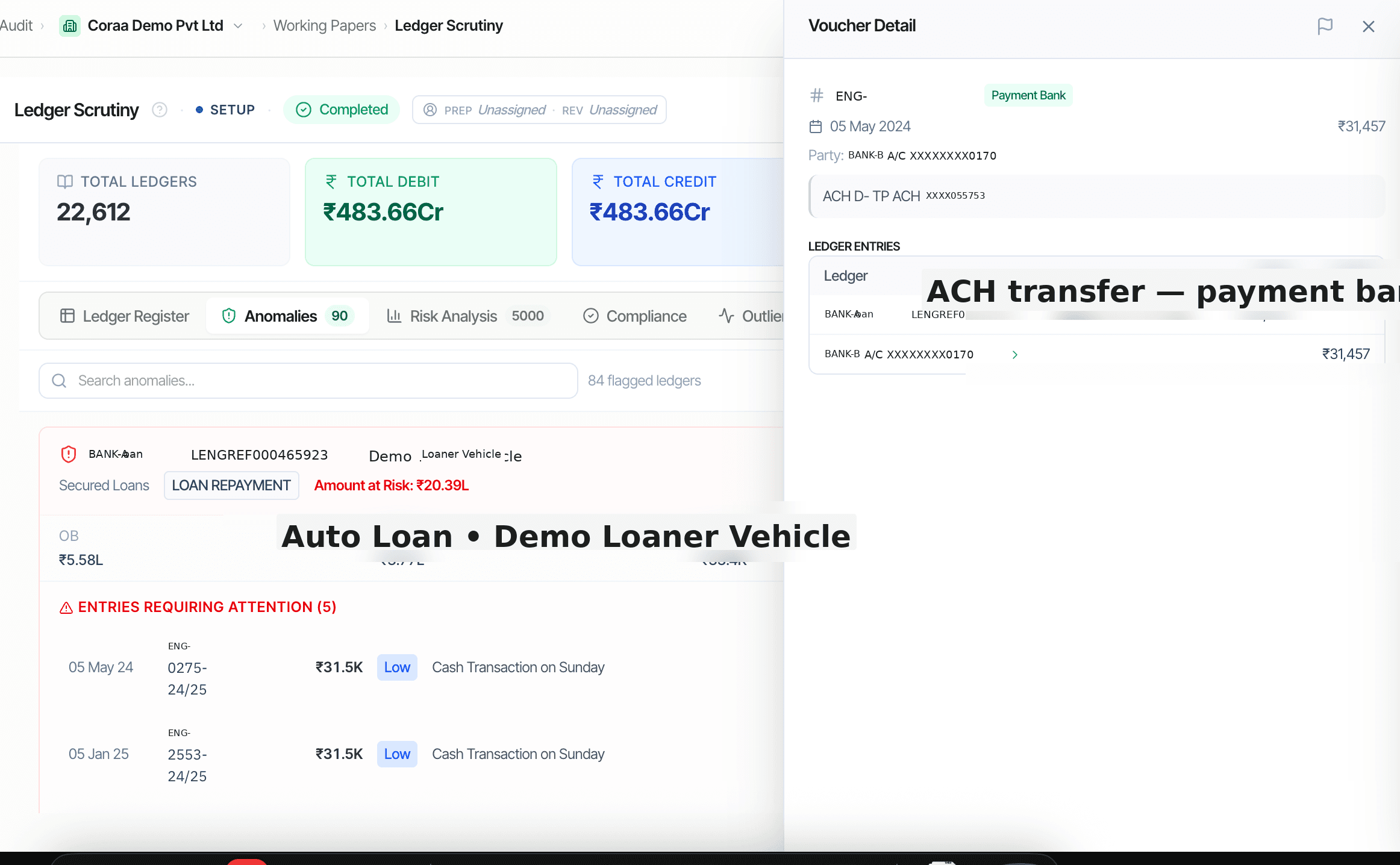
  • Dormant/zero-balance accounts never drop off the tracker
  • Same dormancy data feeds going-concern indicators
  • Cited to SA 520 for the underlying analytical review
  • Visible across CY and PY for trend comparison
Frequently asked

Answers, up front.

No. CORAA flags the ledger sitting on the unexpected side as an exception with the figures behind it. Whether it's a genuine misstatement or an authorized overdraft facility is the auditor's call, recorded against the exception.
It stays on the confirmations tracker and in the going-concern read. It is never dropped from the working paper just because it shows no current-year activity, dormant, zero-balance accounts are exactly where window-dressing hides.
Each confirmation request is a resolution-bridge row with a status that has to resolve, sent, received, matched, or an exception, rather than a single checkbox that can be ticked and forgotten while the underlying confirmation is still outstanding.
See it on a real ledger

Run cash & bank on one of your engagements.

Bring a Trial Balance and a General Ledger. We'll walk through working papers end-to-end on your data, not a sandbox.

Start the free trial →
Cash & Bank Working Paper | Movement Tie-off, SA 505 Confirmations | CORAA