CORAA
AI Modules/Working Papers/Investments
SA 505/540 · Investments· पत्र

Investments

The working paper prints its own decision rule, Type A nil or Type B present, sub-type read structurally from the parent ledger group, valuation routed to the auditor's judgment, and off-book holdings raised as an SA 505 caution.

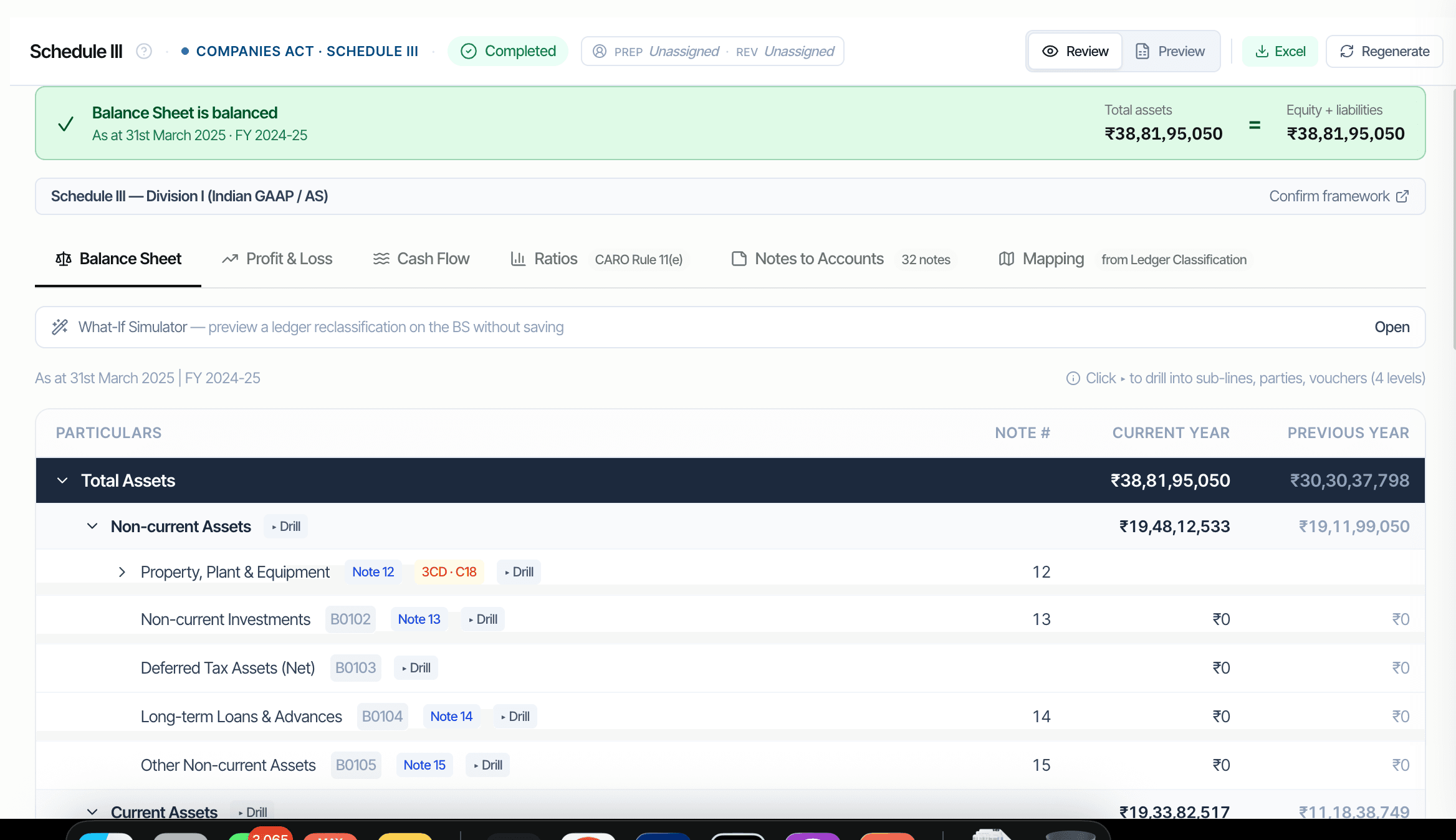
CORAA Schedule III Balance Sheet with three-level drill

Investments prints its own decision rule directly on the page: Type A, a nil conclusion, applies only when both the count and the balance confirm zero; Type B, present, applies whenever there's a balance or a count to test, and routes into the full testing procedures. The auditor sees which branch applied and why, not a black-box conclusion. Sub-type classification, Subsidiary, Associate, or Joint Venture, and Quoted or Unquoted, is read structurally from the parent ledger group in the classification, never guessed from the ledger's name text. Valuation is explicitly routed to the auditor's judgment; CORAA does not value investments itself, it surfaces the cost, any market data on hand, and the classification for the auditor to apply Ind AS 105 or the applicable framework. Investments held but not reflected in the books, off-book holdings, raise an SA 505 caution flag rather than being silently missed.

  • Decision rule printed on the page itself: Type A nil (count and balance both zero) vs Type B present (testing required)
  • Sub-type, Subsidiary / Associate / Joint Venture and Quoted / Unquoted, read structurally from the parent ledger group, never guessed from the name
  • Valuation explicitly routed to the auditor's judgment, CORAA does not value investments itself
  • Off-book investments, held but not reflected in the books, raise an SA 505 caution flag
  • Cited to SA 505/540 and Ind AS 105
Two paths, one ledger

The old way, and ours.

Two paths to the same audit conclusion. One leaves traces; the other doesn't.

Traditional

The old way

  • -Nil-vs-present call made from memory or a quick balance check, not documented as an explicit rule
  • -Sub-type, subsidiary, associate, quoted, unquoted, inferred from the investment's name text, easy to miscategorize
  • -Valuation sometimes computed inside the working paper itself, blurring a system output with an auditor judgment call
  • -Off-book investments caught only if someone happens to ask about them outside the books
Build time: a schedule built fresh each year, with the nil-vs-present call and the sub-type tag both resting on memory rather than a documented rule.
CORAA

On the Ledger

  • Type A / Type B decision rule printed on the page, so the auditor sees exactly which branch applied and why
  • Sub-type read structurally from the parent ledger group every time, never from name-text guessing
  • Valuation explicitly left to the auditor, never computed as a system conclusion
  • Off-book holdings raised as an SA 505 caution flag automatically
Build time: instant. The rule that produced the conclusion is on the page, not buried in a formula.
How it works

Three steps. Every trace logged.

Step 01

Type A / Type B decision, printed

Every investment ledger is run through one rule: if both the count and the balance are zero, it's Type A, nil, confirmed. Anything else is Type B, present, and moves into the full testing path. The rule itself is printed on the page so the auditor sees which branch fired and why.

Step 02

Sub-type, read structurally

Subsidiary, Associate, or Joint Venture, and Quoted or Unquoted, are read off the parent ledger group in the classification structure, never inferred by pattern-matching the investment's name.

Step 03

Valuation to the auditor, off-book to SA 505

CORAA surfaces cost and any available market data but does not value the investment itself, that judgment call under Ind AS 105 or the applicable standard stays with the auditor. Investments held outside the books are flagged as an SA 505 caution rather than going unnoticed.

Inside the module

What you actually get.

Type A / Type B decision rule

The nil-vs-present branch is computed from one explicit rule, count = 0 and balance = 0 for Type A nil, anything else routes to Type B present, and the rule is printed on the working paper itself.

  • Type A: nil, confirmed only when both count and balance are zero
  • Type B: present, routes to full testing procedures
  • Decision rule printed on the page, not a black box
  • CY and PY shown against the same rule

Structural sub-type classification

Subsidiary / Associate / Joint Venture and Quoted / Unquoted are read from the parent ledger group in the classification, so sub-type never depends on guessing from the investment's name.

  • Sub-type read from parent ledger group, structural not name-based
  • Quoted / Unquoted split from the same structure
  • Consistent across every investment ledger
  • Flagged for auditor review where the group itself is ambiguous

Valuation routed to the auditor

Cost and available market data are surfaced; valuation under Ind AS 105 or the applicable framework is explicitly left as the auditor's call, never computed as a system conclusion.

  • Cost and available market data surfaced, not a computed valuation
  • Valuation judgment stays with the auditor
  • Cited to Ind AS 105
  • Prevents a system number silently becoming the reported valuation

Off-book SA 505 caution

Investments the auditee holds but that aren't reflected in the books raise an SA 505 caution flag, so an off-book holding doesn't slip past the working paper unnoticed.

  • Off-book holdings raised as their own caution flag
  • Cited to SA 505 for external evidence procedures
  • Sits alongside the Type A/B conclusion, not folded into it
  • Surfaced for the auditor to pursue further evidence
Frequently asked

Answers, up front.

No. CORAA surfaces cost and any available market data; the valuation judgment under Ind AS 105 or the applicable framework is explicitly left to the auditor and never computed as a system conclusion.
One rule, printed on the page: if both the count and the balance are zero, it's Type A, nil, confirmed. Any other combination is Type B, present, and the full testing procedures apply. The auditor can see exactly which branch fired.
That's an off-book holding, and it raises its own SA 505 caution flag rather than being missed because there's no ledger to test against.
See it on a real ledger

Run investments on one of your engagements.

Bring a Trial Balance and a General Ledger. We'll walk through working papers end-to-end on your data, not a sandbox.

Start the free trial →
Investments Working Paper | Type A/B Decision Rule, SA 540 | CORAA