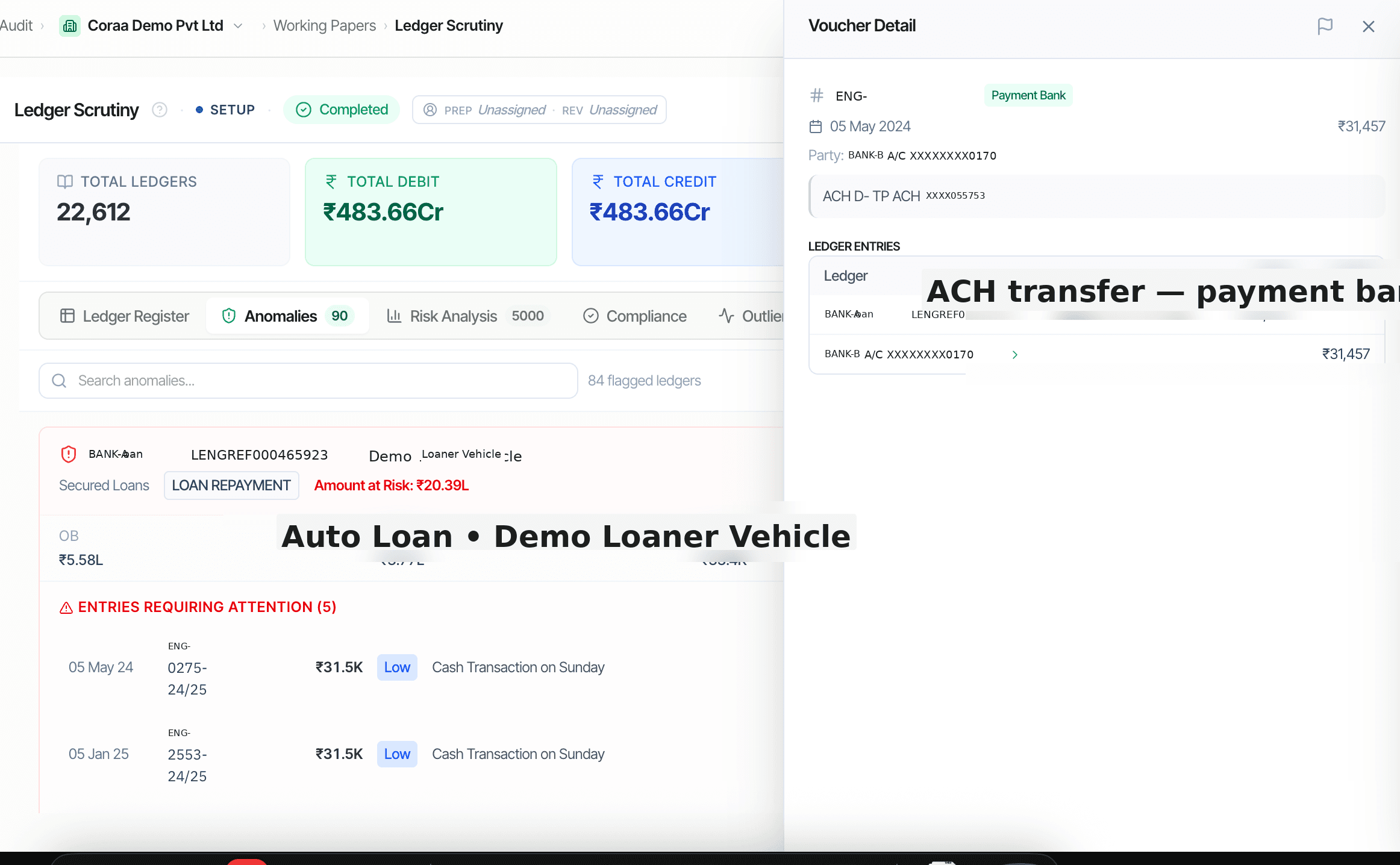
Loans & Advances composes the balance into buckets that respect which side of the balance sheet each account actually sits on, loans and advances given, an asset, kept apart from loans and advances taken, a liability, rather than reviewing both off one blended schedule. A movement check then reads the signed direction of change across the year, not just the opening and closing balance, for every account in the buckets. That distinction matters: a loan account with genuine month-to-month drawdowns and repayments that happens to end the year near where it started is not the same as an account with zero activity all year, and an early version of this check, one that simply summed movement, could not tell the two apart and wrongly flagged the active account as static. The current check reads the actual direction of change, not just the ending number, so that case is no longer caught. Alongside composition and movement, every loan and advance is screened against the related-party register for CARO 3(iii) exposure; when no register has been uploaded, the screen does not fake a pass, it flags itself as unable to run. Sec 185 (loans to directors) and Sec 186 (investments and loans beyond the prescribed limits) checks read off the same composed buckets.
Two paths to the same audit conclusion. One leaves traces; the other doesn't.
Every loan and advance ledger is bucketed by which side of the balance sheet it actually presents on, loans and advances given sit on the Asset side, loans and advances taken sit on the Liability side. The two are never reviewed off one blended schedule.
The static-account check reads the actual direction of change across the year for each account, not just opening vs closing. An account with real month-to-month activity that happens to end near where it started is not flagged as static; only accounts with genuinely no in-year movement are. An earlier version of this check summed movement and could not make that distinction; the current version reads direction of change, so that false positive no longer fires.
Every loan and advance is screened against the related-party register for CARO 3(iii) exposure. When no register has been uploaded, the screen does not report a pass, it flags itself as unable to run, so the gap stays visible to the auditor rather than reading as a clean result.
Loans and advances given, an Asset, and loans and advances taken, a Liability, are composed into separate buckets from the ledger classification, so the presentation always matches which side of the balance sheet each account belongs on.
Flags accounts with genuinely no movement across the year, using the direction of change month to month rather than the ending balance, so an active account that nets back near its opening figure is not caught by mistake.
Every loan and advance is checked against the related-party register. An empty or missing register does not produce a quiet pass, it produces its own visible flag.
Loans to directors or connected persons, and investments or loans beyond the prescribed Companies Act limits, are flagged off the same composed buckets used for the rest of the working paper.