CORAA
AI Modules/Working Papers/Related Parties
SA 550 · Related Parties· पत्र

Related Parties

Register-first: an empty related-party register is itself a HIGH finding, and every candidate related party is surfaced for the auditor's judgment, never auto-asserted.

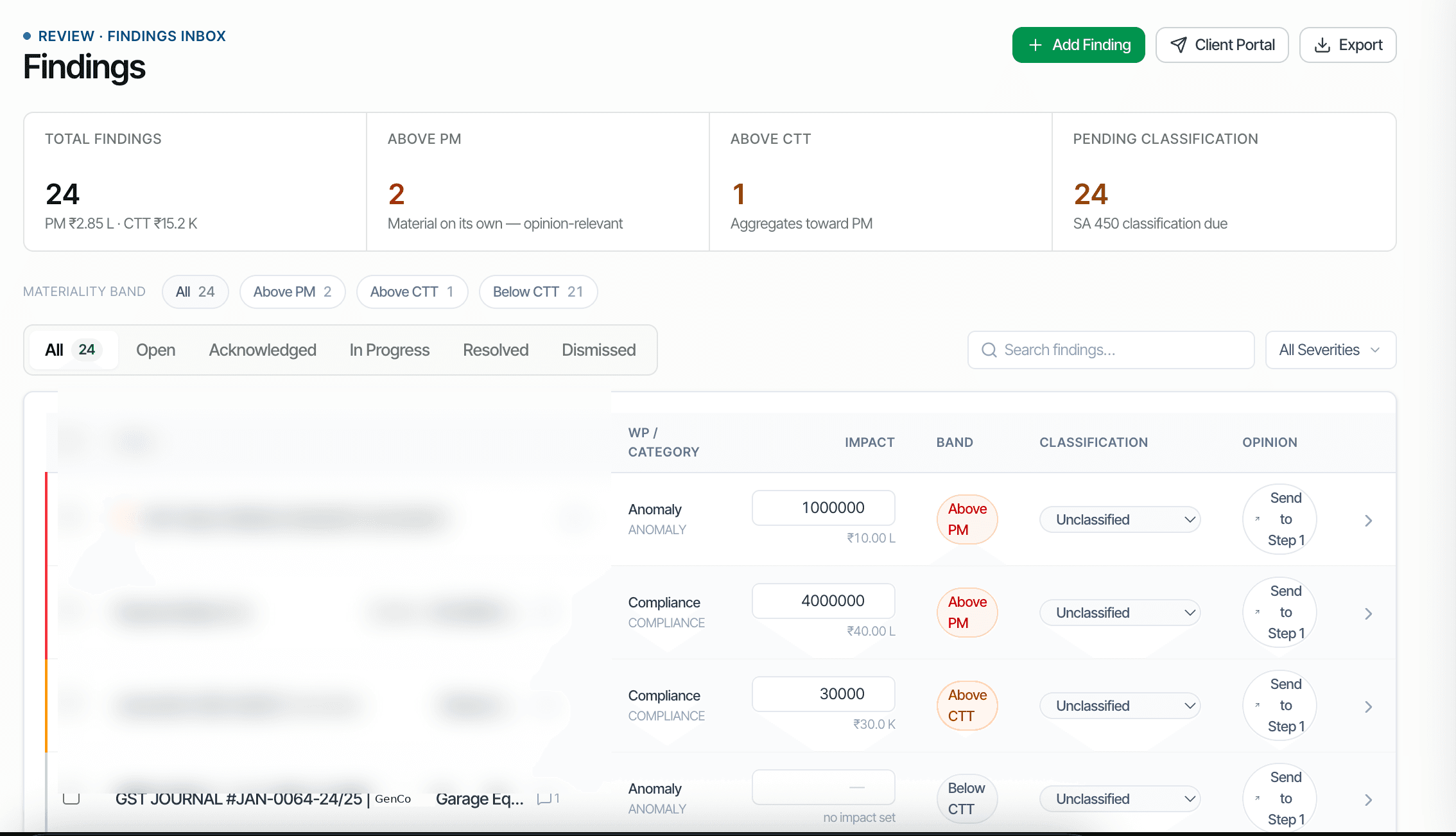
CORAA findings-style register interface for evidence review

Related Parties is rebuilt from scratch around one rule: no register is not a free pass. If the auditee has not uploaded a related-party register, CORAA does not silently skip SA 550 procedures, it raises a HIGH finding for the missing register itself and still runs its candidate search against whatever data it has, ledger names, common directors, PAN, or address where the data holds them, and transaction patterns that resemble related-party dealing. Every match produced this way is a candidate, CORAA never asserts that a party is related, only that it looks like one worth the auditor's judgment call. The auditor reviews each candidate and confirms it into the register, or dismisses it with a documented reason; only confirmed entries feed the Schedule III related-party note and Form 3CD Clause 23.

  • Empty related-party register raises a HIGH finding, not a silent pass
  • Candidate related parties surfaced from ledger names, director/PAN/address overlap, and transaction patterns
  • CORAA never asserts a party is related, only that it's a candidate for review
  • Auditor confirms or dismisses each candidate; only confirmed entries reach the note
  • Confirmed related parties feed the Schedule III note and Form 3CD Clause 23
  • Cited to SA 550 throughout
Two paths, one ledger

The old way, and ours.

Two paths to the same audit conclusion. One leaves traces; the other doesn't.

Traditional

The old way

  • -Related-party register requested from management once, taken as complete if provided
  • -No register on file usually means the procedure gets skipped rather than escalated
  • -Candidate related parties found by manual review of ledger names, easy to miss a common director
  • -Confirmation of related-party status and the disclosure note built in the same pass, judgment and mechanics blurred together
No register, no procedure: SA 550 exposure hides in exactly the engagements with the weakest records.
CORAA

On the Ledger

  • Missing register raises a HIGH finding automatically, procedures still run regardless
  • Candidate search runs against ledger names, director/PAN/address overlap, and transaction patterns
  • Every candidate stays a candidate until the auditor confirms it into the register
  • Confirmed entries, and only confirmed entries, flow to the Sch III note and Clause 23
  • Full candidate list, including dismissed ones, stays in the working paper for a reviewer to re-check
No register is a finding, not a shortcut. The judgment call stays with the auditor.
How it works

Three steps. Every trace logged.

Step 01

Register check, first

CORAA checks for an uploaded related-party register before anything else. If none exists, it raises a HIGH finding for the gap and proceeds with candidate search regardless, SA 550 procedures don't wait on management's paperwork.

Step 02

Candidate surfacing, not conclusion

Ledger names, shared directors, PAN, or address where the data holds them, and transactions with unusual terms are compared against the register, or its absence, to produce a candidate list. Each candidate carries the evidence that raised it. CORAA never marks a party related, only a candidate.

Step 03

Auditor confirms into the register

The auditor reviews each candidate, confirms it into the related-party register or dismisses it with a documented reason. Only confirmed parties feed the Schedule III related-party note and Form 3CD Clause 23; the full candidate list, including dismissed ones, stays in the working paper.

Inside the module

What you actually get.

Register-first HIGH finding

An empty or missing related-party register doesn't quietly waive SA 550, it becomes the working paper's own HIGH-severity finding, with the candidate search still run alongside it.

  • Missing register: automatic HIGH finding
  • Finding sits in the caption paper's own Exceptions section
  • Candidate search continues regardless of the register's state
  • Cited to SA 550 for the underlying requirement

Candidate surfacing, not auto-assertion

Ledger names, director/PAN/address overlap where the data holds them, and unusual transaction terms produce a candidate list. Every candidate carries the specific evidence that raised it.

  • Ledger-name pattern matches
  • Director, PAN, or address overlap where available
  • Unusual transaction-term signals
  • Never a determination, always a candidate for review

Confirm-or-dismiss workflow

The auditor works the candidate list one entry at a time, confirming into the register or dismissing with a reason. Both outcomes are logged; nothing is silently discarded.

  • One-by-one confirm or dismiss
  • Documented reason required on dismissal
  • Full history retained in the working paper
  • Reviewer sees confirmed and dismissed candidates alike

Sch III note and Clause 23 feed

Only confirmed related parties, never candidates, populate the Schedule III related-party note and Form 3CD Clause 23, so the statutory disclosure reflects the auditor's confirmed judgment, not a machine guess.

  • Sch III related-party note auto-populated from confirmed entries
  • Form 3CD Clause 23 cross-tied to the same confirmed list
  • No candidate reaches a statutory output unconfirmed
  • Change to the register recomposes both outputs
Frequently asked

Answers, up front.

CORAA still runs the candidate search against ledger names, available director/PAN/address data, and transaction patterns, and still raises a HIGH finding if no register was uploaded. A management assertion of 'none' does not stop the SA 550 procedure from running.
No. Every match the candidate search produces stays a candidate, carrying the evidence that raised it, until the auditor reviews it and confirms it into the register. CORAA surfaces evidence; it does not decide related-party status.
It stays in the working paper with the auditor's documented reason for dismissal, visible to reviewers and in any re-performance of the file. Nothing is deleted; a dismissed candidate from one year can resurface for review if the same pattern appears again.
See it on a real ledger

Run related parties on one of your engagements.

Bring a Trial Balance and a General Ledger. We'll walk through working papers end-to-end on your data, not a sandbox.

Start the free trial →
Related Parties Working Paper | SA 550, Register-First | CORAA