CORAA
AI Modules/Working Papers/Capital & Reserves
Sch III · Capital & Reserves· पत्र

Capital & Reserves

A SOCIE-style movement bridge, Opening + Introductions − Drawings + Retained Earnings = Closing, an appropriation-flag check against what the books actually show, and an honest FLAG when the P&L integrity tie doesn't reconcile.

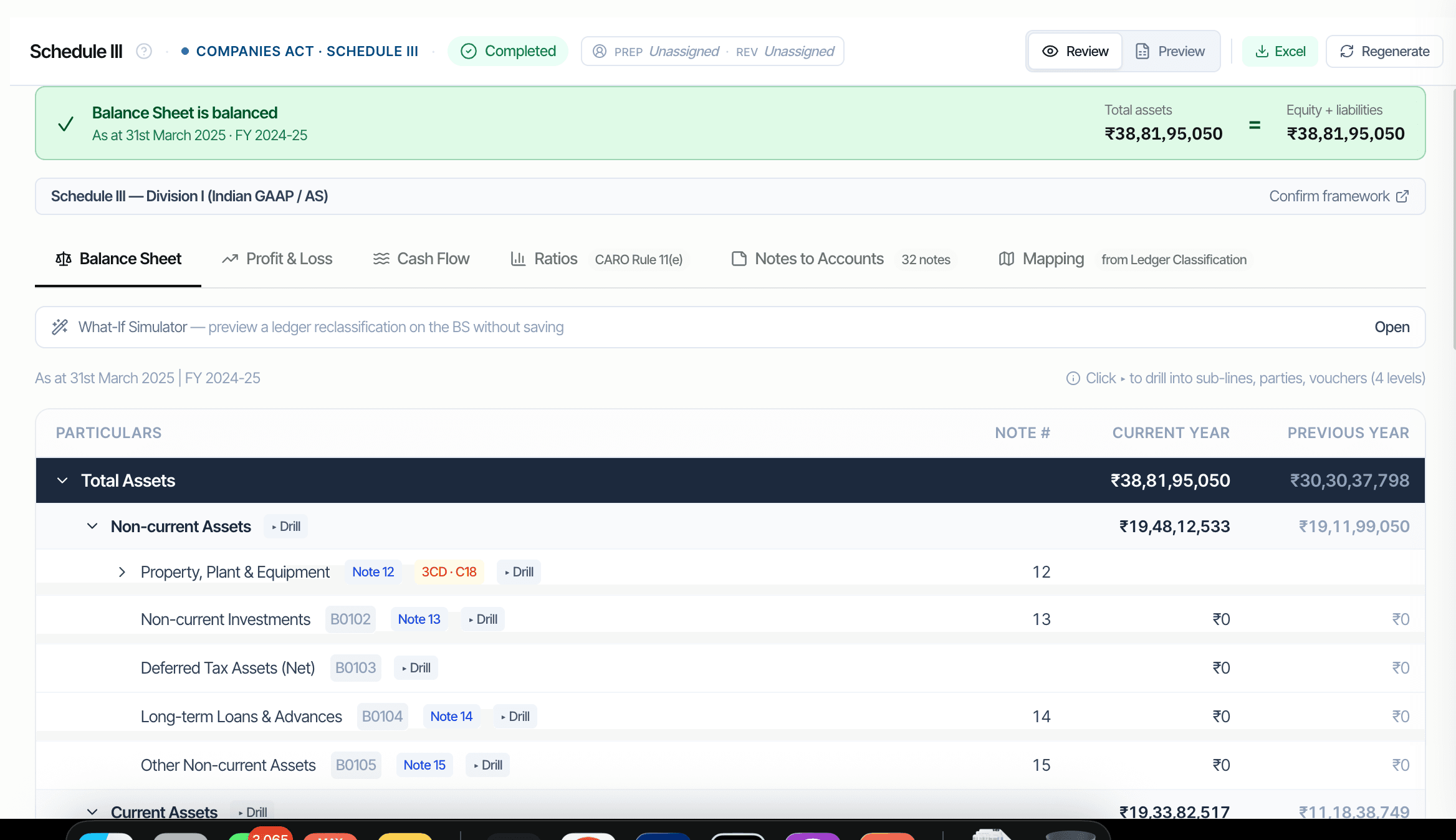
CORAA Schedule III Balance Sheet with equity movement drill

Capital & Reserves composes a movement bridge in the shape of a Statement of Changes in Equity: Opening, plus Share or Capital Introductions, minus Drawings, plus Retained Earnings for the year, equals Closing, printed as an actual reconciling bridge rather than a single net figure. An appropriation-flag check runs alongside it, testing whether dividends and transfers to reserve are what the books actually show, never assumed from a standard pattern. The working paper also carries an integrity tie: that the year's movement in the P&L account reconciles to the reported net profit for the year. When it doesn't tie, that's an honest FLAG, never silently forced to balance. The paper is framework-aware, presenting the bridge differently for a company, share capital and reserves under Schedule III, than for an LLP or partnership firm, partners' capital and current accounts. An earlier version of this check used to raise "unclassified equity, High" on any company that simply carries a normal accumulated profit and loss account balance; that false positive has been fixed in the current build.

  • SOCIE-style movement bridge: Opening + Introductions − Drawings + Retained Earnings = Closing, printed as a reconciling bridge, not a net number
  • Appropriation-flag check tests dividends/transfers-to-reserve against what the books actually show, never assumed
  • Integrity tie: ΔP&L account vs the year's reported net profit; a mismatch is an honest FLAG, never forced to balance
  • Framework-aware: presents differently for a company (Schedule III) vs an LLP or partnership firm (partners' capital/current accounts)
  • Fixed a prior false positive that flagged "unclassified equity, High" on any company simply carrying a normal accumulated P&L balance
  • Cited to Schedule III and Companies Act Sec 128
Two paths, one ledger

The old way, and ours.

Two paths to the same audit conclusion. One leaves traces; the other doesn't.

Traditional

The old way

  • -Equity movement summarized as a single net change, not broken into a bridge an outsider could re-perform
  • -Dividend and reserve-transfer appropriations assumed to follow a standard pattern rather than checked against what the books show
  • -P&L movement vs reported net profit reconciled by eye, if at all, with mismatches easy to miss or silently smoothed over
  • -The same equity template applied to companies and LLPs alike, even though the presentation should differ
Build time: half a day building the equity note by hand. A mismatch between P&L movement and reported profit is easy to paper over rather than flag.
CORAA

On the Ledger

  • Bridge printed in full, Opening through Closing, in SOCIE shape, not just a net movement figure
  • Appropriation flags test what the books actually show, not an assumed pattern
  • ΔP&L vs net profit tie is an honest FLAG when it doesn't reconcile, never forced
  • Presentation adapts automatically to company vs LLP/partnership framework
  • Unclassified-equity false positive on ordinary accumulated P&L balances fixed
Build time: instant. A mismatch stays a visible flag, it's never quietly balanced away.
How it works

Three steps. Every trace logged.

Step 01

The SOCIE-style bridge

Opening equity, plus share or capital introductions during the year, minus drawings, plus retained earnings for the year, is composed and printed as an actual reconciling bridge to the closing balance, in Statement of Changes in Equity shape, so each component is visible rather than folded into one net movement figure.

Step 02

Appropriation flags and the P&L integrity tie

Dividend declarations and transfers to reserve are tested against what the books actually record, not assumed from a standard pattern. Separately, the year's movement in the P&L account is checked against the reported net profit for the year; where the two don't tie, that mismatch is raised as an honest FLAG rather than forced to reconcile.

Step 03

Framework-aware presentation

The bridge and its labels adapt to the entity type, share capital and reserves under Schedule III for a company, partners' capital and current accounts for an LLP or partnership firm, so the working paper reads correctly for the entity in front of it.

Inside the module

What you actually get.

Movement bridge, SOCIE shape

Opening + Introductions − Drawings + Retained Earnings = Closing is printed as a full reconciling bridge, matching the Statement of Changes in Equity shape, not compressed into a single net movement number.

  • Opening, Introductions, Drawings, Retained Earnings, Closing shown as separate bridge rows
  • SOCIE-style presentation, re-performable line by line
  • CY and PY bridges shown side by side
  • Cited to Schedule III

Appropriation-flag check

Dividend and reserve-transfer appropriations are tested against what the books actually show for the year, rather than assumed to follow a standard pattern.

  • Tests actual recorded dividends and reserve transfers
  • Flags where appropriations don't match the books
  • Surfaced as evidence, not an auto-correction
  • Cited to Companies Act Sec 128

ΔP&L integrity tie, honest FLAG

The year's movement in the P&L account is checked against the reported net profit for the year. When it doesn't reconcile, the working paper raises an honest FLAG rather than silently forcing the two to match.

  • ΔP&L account vs reported net profit for the year
  • Mismatch raised as an explicit FLAG, never forced to balance
  • Flag carried into the working paper's own exceptions
  • Fixed a prior false positive on ordinary accumulated P&L balances

Framework-aware presentation

The bridge presents differently depending on entity type, Schedule III share capital and reserves for a company, partners' capital and current accounts for an LLP or partnership firm.

  • Company: Schedule III share capital and reserves shape
  • LLP/partnership: partners' capital and current accounts shape
  • Labels and bridge rows adapt automatically to the entity type
  • Same underlying movement logic across both
Frequently asked

Answers, up front.

No. CORAA raises the mismatch as an honest FLAG with the figures behind it, ΔP&L account against reported net profit. Whether it's a genuine misstatement, a rounding difference, or something else is the auditor's judgment call.
An earlier version of the check used to flag any company simply carrying a normal accumulated profit-and-loss account balance as "unclassified equity, High", which was a false positive. The current build fixes that; a normal accumulated P&L balance no longer triggers it.
No. The bridge is framework-aware: Schedule III share capital and reserves for a company, partners' capital and current accounts for an LLP or partnership firm, with the presentation adapting automatically to the entity type.
See it on a real ledger

Run capital & reserves on one of your engagements.

Bring a Trial Balance and a General Ledger. We'll walk through working papers end-to-end on your data, not a sandbox.

Start the free trial →
Capital & Reserves Working Paper | SOCIE Bridge, Schedule III | CORAA