CORAA
AI Modules/Working Papers/Lead Schedules
Schedule III Balance Heads· पत्र

Lead Schedules

Per Schedule III balance head with three-level drill to source vouchers.

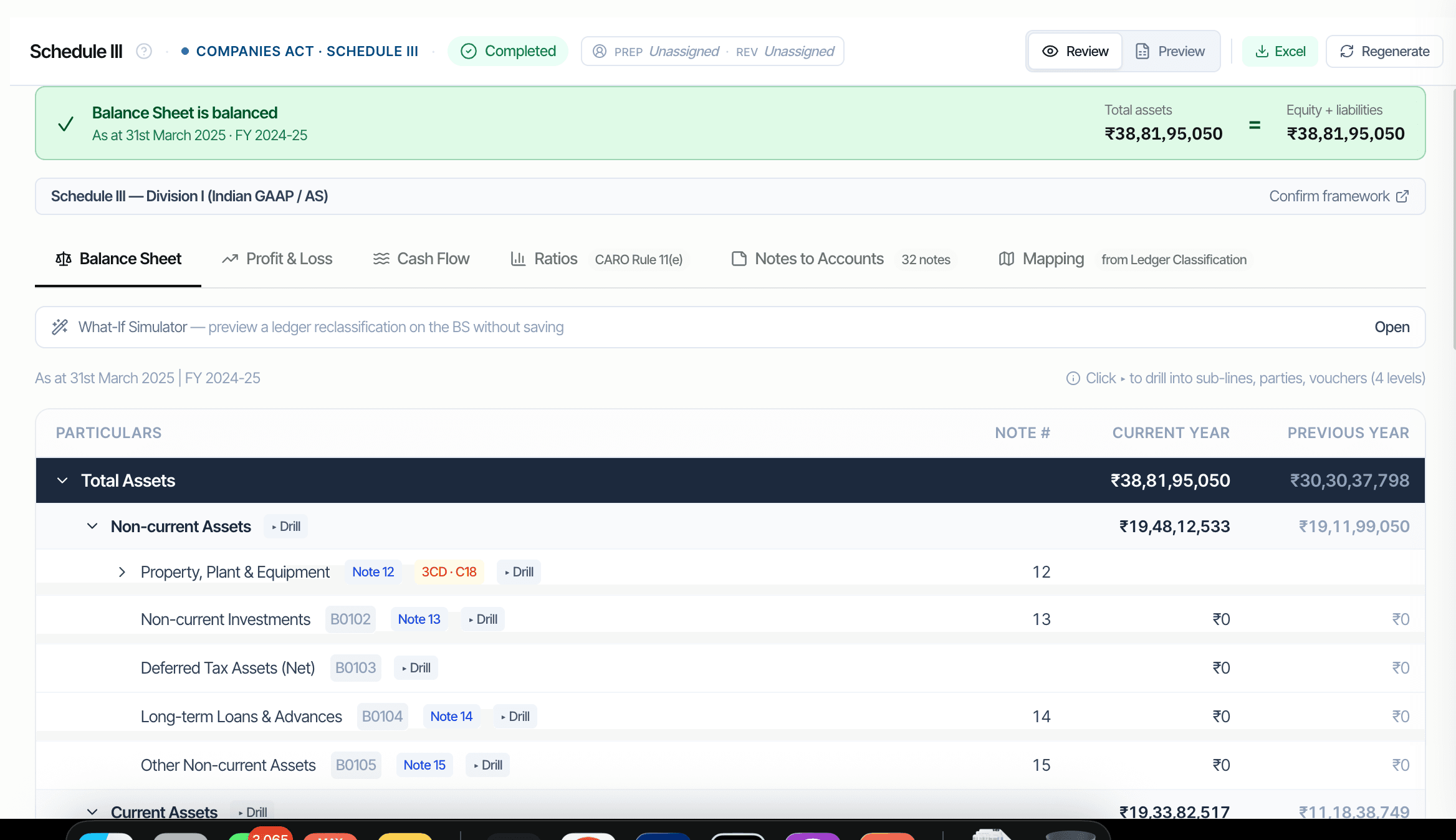
CORAA Schedule III Balance Sheet with three-level drill

Lead schedules are the auditor's primary working paper for every Balance Sheet and P&L head. CORAA composes them automatically from the Universal Audit Ledger. Each schedule shows CY and PY columns with variance analysis. Three-level drill: balance head, ledgers under it, parties under the ledger, vouchers under the party. Tie-out enforced at composition: Total Assets must equal Total Equity plus Total Liabilities.

  • Per Schedule III balance head, Division I or Division II
  • Three-level drill: line, ledgers, parties, vouchers
  • CY and PY columns with variance flag at 25%
  • Tie-out invariant: Assets = Equity + Liabilities (re-checked on every change)
  • Exports to firm's Excel template in OneDrive
  • Live formulas: change Ledger Classification, lead schedules recompute
Two paths, one ledger

The old way, and ours.

Two paths to the same audit conclusion. One leaves traces; the other doesn't.

Traditional

The old way

  • -Lead schedules built by article assistants in Excel
  • -Each schedule a separate workbook with manual VLOOKUPs to the trial balance
  • -PY figures copy-pasted from prior-year working paper file
  • -Tie-out checked at the end and reworked if BS doesn't balance
Build time: 2-3 days per audit. Errors: typical. Tie-out failures caught late.
CORAA

On the Ledger

  • Lead schedules composed from UAL via live formulas
  • PY figures pulled from prior-year audited closing automatically
  • Three-level drill from any line for evidence
  • Tie-out enforced before composition; BS cannot fail to balance
  • Reclassify a ledger and every dependent schedule recomputes
Build time: instant. Errors: arithmetic-impossible. Tie-out: enforced.
How it works

Three steps. Every trace logged.

Step 01

Schedule III mapping drives composition

Once Ledger Classification's Schedule III dimension is set, every ledger has a Sch III line code. Lead schedules aggregate ledgers by line code using SUMIFS over the Trial Balance.

Step 02

Three-level drill

Click any Sch III line to expand to its constituent ledgers. Click any ledger to see the parties contributing to it. Click any party to see the source vouchers. Read-only at all three levels; corrections happen via Ledger Classification.

Step 03

Variance analysis built in

CY and PY columns side by side. Variances above 25% flagged for explanation (CARO Rule 11(e) trigger). The variance note feeds CARO 2020 Clause 3(xi)(e) directly.

Inside the module

What you actually get.

Schedule III balance head coverage

Every line code from A1 Equity Share Capital through F7 Other Current Assets, plus P1 Revenue through P9 Other Expenses. Division I for AS; Division II for Ind AS.

  • Division I: Indian GAAP / AS
  • Division II: Ind AS
  • ~90 line codes covered
  • Auto-classification from Ledger Classification

Three-level drill-down

Three levels deep, all read-only. Corrections happen at the Ledger Classification screen, which propagates back to every dependent lead schedule.

  • Level 1: Sch III line totals
  • Level 2: constituent ledgers
  • Level 3: parties under each ledger
  • Level 4: source vouchers under each party

Tie-out invariant enforced

Total Assets must equal Total Equity plus Total Liabilities. CORAA refuses to mark a lead schedule 'ready' if the tie-out fails by more than ₹1. Same for the P&L bottom line feeding Reserves & Surplus.

  • BS tie-out: Assets = Equity + Liabilities
  • P&L tie-out: bottom line feeds Reserves
  • Cash Flow tie-out: closing cash matches BS
  • Tie-out re-checked on every change

Firm-template Excel export

Lead schedules export to standard Excel in the firm's own template format. OneDrive integration means the Excel lives in the firm's cloud, not CORAA's.

  • Drop firm template once, used thereafter
  • Per balance head export
  • Bundled export for full lead schedule pack
  • OneDrive / SharePoint / local drive
Frequently asked

Answers, up front.

Ledger Classification supports percentage-allocated mapping. For example, an accrual ledger that's 40% current and 60% non-current gets allocated accordingly; the lead schedule renders both portions on their respective Schedule III lines with the percentage shown in the drill.
Three sources, in priority order: (1) prior-year audit report uploaded at Engagement Setup, OCR-extracted; (2) prior-year Trial Balance Excel uploaded; (3) prior-year CORAA engagement, if it exists in your workspace. The source is shown next to the PY figure for verification.
Yes. Every line supports inline auditor notes that flow into the audit working paper file. Notes are versioned per the engagement log and visible to peer reviewers.
See it on a real ledger

Run lead schedules on one of your engagements.

Bring a Trial Balance and a General Ledger. We'll walk through working papers end-to-end on your data, not a sandbox.

Start the free trial →Book a walk-through
Audit Lead Schedules AI | Schedule III Balance Heads with Drill | CORAA | CORAA