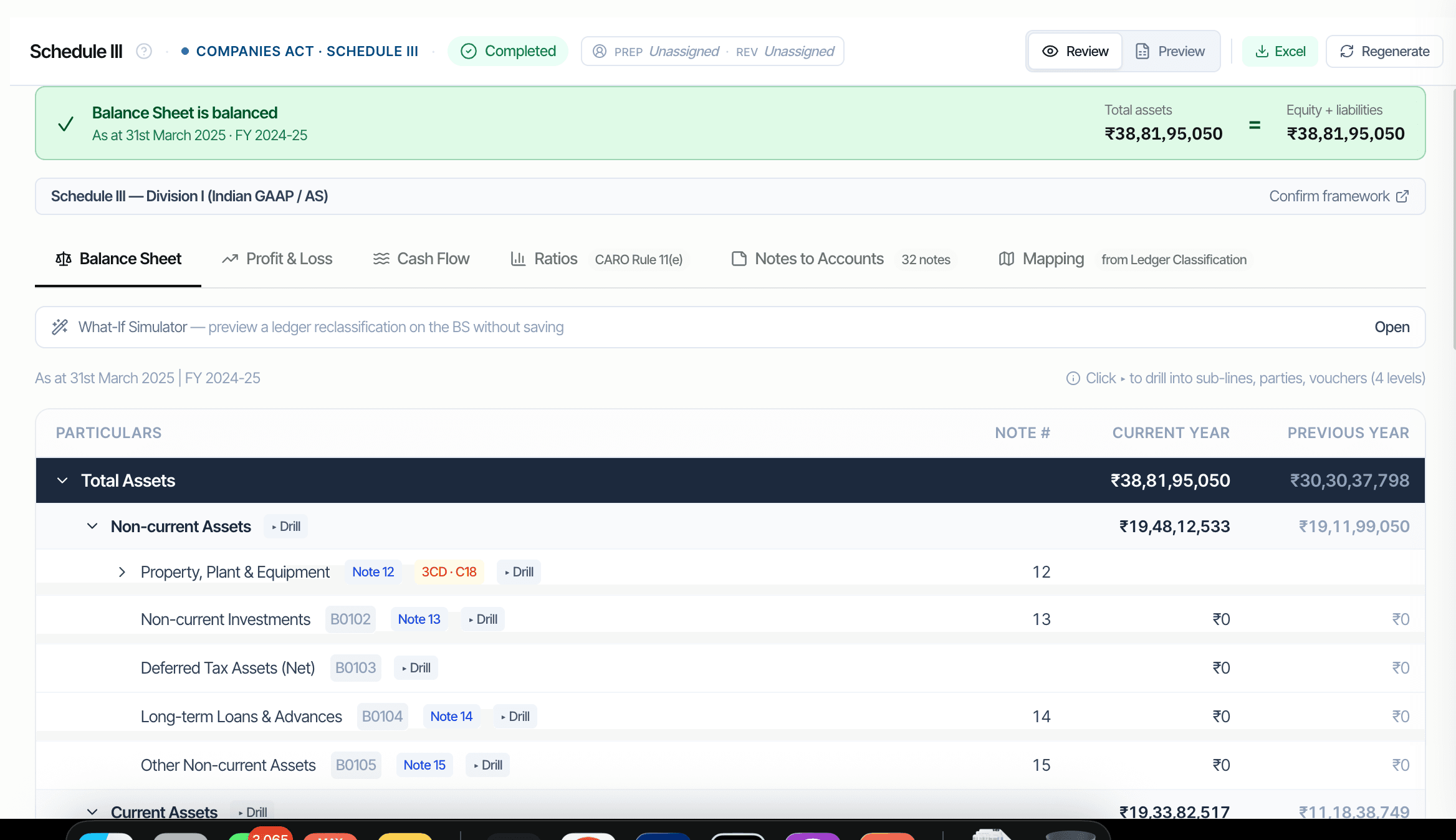
Schedule III is the heart of the financial statements — Balance Sheet, P&L, Cash Flow, ratios, depreciation, Notes and Mapping in one Working Paper. CORAA drafts every line from the books via Ledger Mapping. The framework stays a setting until you lock: switch Divisions and the faces re-render. When the equation ties, Lock & generate seals the statements and produces the Notes from the locked figures — so a note can never disagree with the face above it.
Two paths to the same audit conclusion. One leaves traces; the other doesn't.
Every ledger carries a Sch III line code from the 4-dim Ledger Mapping setup. BS and P&L compose via SUMIFS over Trial Balance, aggregating by Sch III line. Cash Flow derives from BS movement plus P&L non-cash adjustments.
BS, P&L, Cash Flow (indirect method), Ratios (the 11 Schedule III ratios with 25% variance flagging), Notes (32 disclosures with CY vs PY), Mapping (read-only view of classification).
The framework choice is a setting until you lock — switch Divisions and the faces re-render; move a grouping and the statements recompute. When the placements are confirmed and the equation ties, Lock & generate seals the statements and produces the Notes from the locked figures. Unlock, adjust, re-lock — version history keeps every generated set.
Balance Sheet, P&L, Cash Flow (indirect), Ratios, Schedule II Depreciation, Notes to Accounts, Disclosures, and Mapping (read-only from Ledger Mapping). Every figure recomputes from the mapped ledgers — re-map and regenerate; nothing is keyed by hand.
Most companies use Division I (Indian GAAP / AS); listed and large unlisted entities use Division II (Ind AS); NBFCs follow Division III; LLPs and non-corporate entities get their own formats. The framework selector switches the template, line names and disclosures — and stays switchable until you lock.
Any face line opens to the groupings and ledgers behind it, then the parties, then the vouchers. Marginal placement calls get decided on evidence — and the Mapping tab records where every rupee landed.
CARO 2020 requires reporting on 11 financial ratios. CORAA computes them automatically and flags any ratio with more than 25% variance vs prior year, requiring auditor disclosure of the reason for variance.