CORAA
AI Modules/Engagement Setup/लेजर वर्गीकरण
4-Dimensional वर्गीकरण· सेटअप

लेजर वर्गीकरण

Classify लेजर under ICAI guidelines once. वर्ष 2 opens with zero लेजर to reclassify.

CORAA लेजर वर्गीकरण across four statutory dimensions

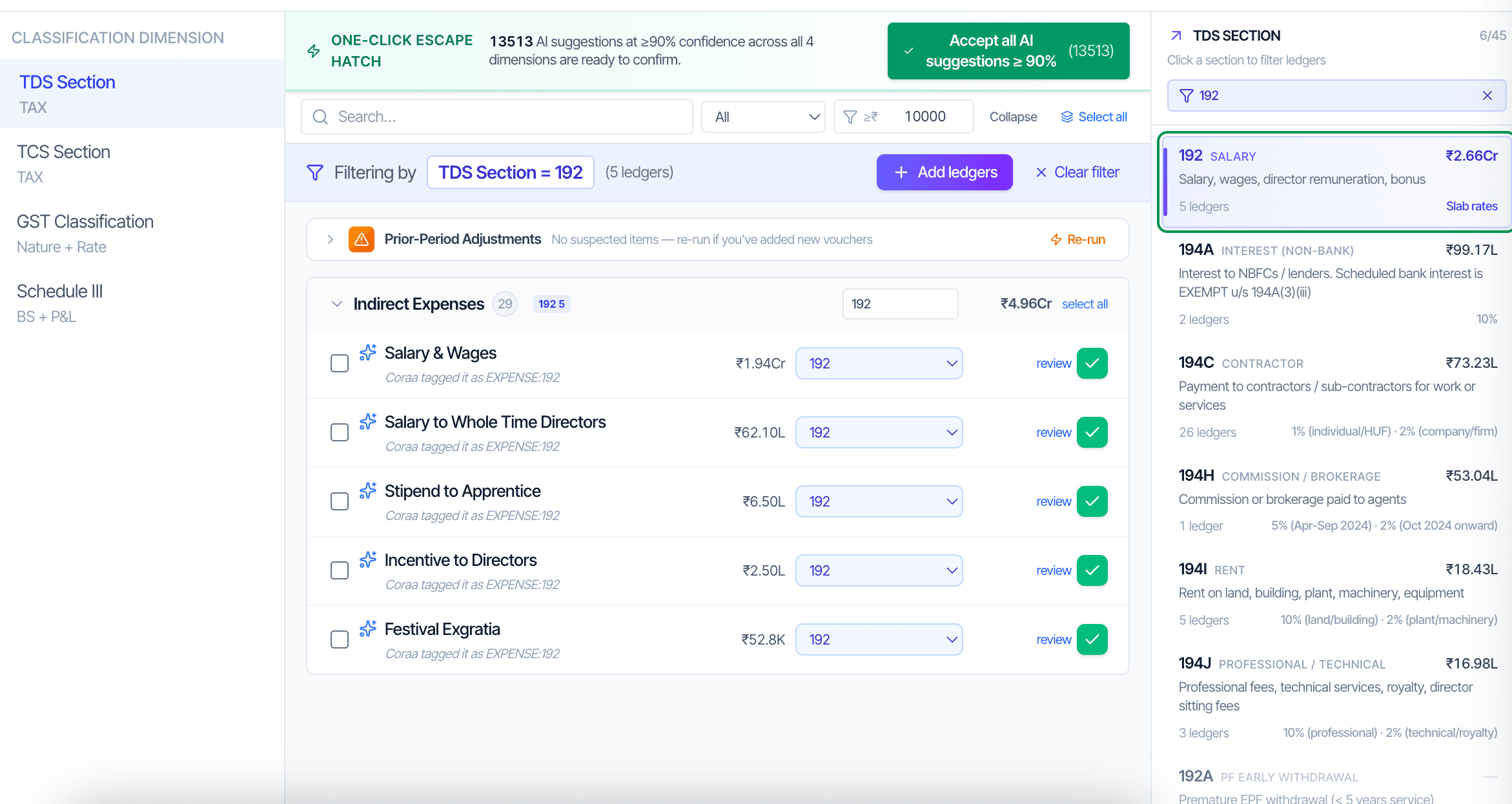
Every वाउचर in the books has four statutory consequences: which TDS खंड applies (192 to 206), which TCS खंड (206C variants), which GST nature (नहींrmal, RCM, Composition, Exempt, Nil-rated), and which Schedule III line code (A1 Equity Capital through P9 Other Expenses). CORAA captures सभी four classifications in one लेजर वर्गीकरण exercise. AI auto-classifies roughly 80 percent on first ingest; the ऑडिटर confirms the residual. Mappings persist वर्ष-on-वर्ष.

  • Four statutory dimensions in one exercise: TDS, TCS, GST, Schedule III
  • AI auto-classifies ~80% of लेजर on first ingest
  • ऑडिटर confirms or overrides the residual 20%
  • One-click acceptance for AI suggestions with ≥90% confidence
  • Mappings persist across वित्तीय वर्ष
  • Rule weights adapt per क्लाइंट एंगेजमेंट
Two paths, one ledger

The old way, and ours.

Two paths to the same audit conclusion. One leaves traces; the other doesn't.

Traditional

The old way

  • -ऑडिटर classifies लेजर from scratch every वित्तीय वर्ष
  • -TDS खंड, GST nature, Schedule III line maintained in separate Excel sheets
  • -Inconsistencies between sheets create मिलान effort downstream
  • -Senior पार्टनर re-explains वर्गीकरण logic to लेख assistants annually
First ऑडिट वर्गीकरण: 4-6 घंटे of पार्टनर समय. Repeats every वर्ष.
CORAA

On the Ledger

  • Single लेजर वर्गीकरण screen captures सभी four dimensions
  • AI pre-classifies लेजर names against ICAI मानक on Auditing guidance
  • वर्ष 1: 30-45 मिनट समीक्षा of AI suggestions
  • वर्ष 2: typically zero लेजर requiring reclassification
  • ऑडिट log preserves who classified what and when, per SA 230
वर्ष 1 वर्गीकरण: under 45 मिनट. वर्ष 2 onwards: typically under 5 मिनट.
How it works

Three steps. Every trace logged.

Step 01

AI pre-classifies on ingest

After the ERP डेटा ingests, the AI reads every लेजर name and narration pattern, then proposes classifications across TDS खंड, TCS खंड, GST nature, and Schedule III line. Each suggestion shows a confidence score.

Step 02

ऑडिटर समीक्षाएँ and confirms

The लेजर वर्गीकरण screen lists लेजर grouped by confidence band. Above 90 percent confidence: one-click accept सभी. Between 70 and 90 percent: समीक्षा individually. Below 70 percent: requires explicit ऑडिटर वर्गीकरण.

Step 03

Mappings persist वर्ष-on-वर्ष

Classifications are stored against the एंगेजमेंट, not the वर्ष. अगला वर्ष's ऑडिट opens with the same लेजर names already classified. The ऑडिटर समीक्षाएँ only what changed: नया लेजर, renamed लेजर, or लेजर where Schedule III mapping shifted.

Inside the module

What you actually get.

TDS खंड dimension

Maps every applicable लेजर to its TDS खंड under the Income Tax Act: Sec 192 Salary, 194A Interest non-bank, 194C Contractor, 194I Rent, 194JB प्रोfessional, 194Q Goods Purchase, 194R Perquisites, 206AB नहींn-filer higher rate. Drives Form 3CD Clause 34(a).

  • Threshold checks per खंड
  • Rate verification (10% Bldg, 2% P&M for 194I, etc.)
  • Lower-deduction certificate (Sec 197) handling
  • Sec 206AB non-filer flagging

TCS खंड dimension

Maps sale लेजर to TCS खंड under Sec 206C: 206C(1) Scrap, 206C(1F) Motor Vehicle over ₹10L, 206C(1G) Overseas remittance, 206C(1H) Sale of Goods over ₹50L buyer-wise.

  • Buyer-wise cumulative threshold tracking for 206C(1H)
  • Per-invoice threshold for 206C(1F)
  • Form 27C zero-rate declaration handling
  • Sec 206CCA non-filer higher rate

GST Nature dimension

Classifies each लेजर by GST nature: नहींrmal (ITC eligible), RCM (reverse charge), Composition (no ITC), Exempt, Nil-rated, Zero-rated (exports), Blocked (Sec 17(5)), नहींn-GST.

  • खंड 17(5) blocked credit detection
  • RCM applicability per Sec 9(3) / 9(4)
  • Rule 36(4) ITC limit feeds from this वर्गीकरण
  • Used by Form 3CD Clause 44 GST-wise break-up

Schedule III Line dimension

Maps every लेजर to its Schedule III line code per Companies Act 2013 Schedule III. Division I (Indian GAAP / AS) for most entities; Division II (Ind AS) for सूचीबद्ध and large unlisted. Drives Balance Sheet, P&L, Cash Flow, नहींtes to खाते, and ratios.

  • ~90 line codes from A1 Equity through P9 Other Expenses
  • फ़्रेमवर्क selector toggles between Division I and Division II
  • Current vs non-current split for amendment 2021 एजिंग
  • Mapping tab on Schedule III WP is पढ़ें-only from this वर्गीकरण
Frequently asked

Answers, up front.

CORAA reads लेजर names, group hierarchy from the Chart of खाते, and narration patterns from sample वाउचर. It matches against a dictionary of ICAI-aligned classifications built from prior एंगेजमेंट and मानक on Auditing guidance. Each proposal carries a confidence score from 0 to 100. Above 90 is high-confidence; the ऑडिटर can accept सभी such suggestions in one click.
Mixed-purpose लेजर need split वर्गीकरण. CORAA flags these as 'optional GST वर्गीकरण' and lets the ऑडिटर either subdivide the लेजर or apply GST at the वाउचर level rather than the लेजर level. For Schedule III mapping, लेजर can split between two lines with a percentage allocation.
If the GL Code is the same and only the name changed, the वर्गीकरण persists by code. If a नया GL Code appears, it shows up as 'unclassified' and the ऑडिटर classifies it once. The ऑडिट log captures the rename इवेंट.
See it on a real ledger

Run लेजर वर्गीकरण on one of your engagements.

Bring a Trial Balance and a General Ledger. We'll walk through engagement setup end-to-end on your data, not a sandbox.

Start the free trial →Book a walk-through
Ledger Classification AI | TDS, TCS, GST, Schedule III in One Setup | CORAA | CORAA