CORAA
AI Modules/Working Papers/Cash Flow Workings
AS 3 · Ind AS 7· पत्र

Cash Flow Workings

Indirect method per AS 3 / Ind AS 7. Reconciles to Cash and Bank closing balance.

Cash Flow Workings indirect method

AS 3 (Indian GAAP) and Ind AS 7 prescribe the Cash Flow Statement structure: Operating, Investing, and Financing activities with the indirect method (most common in India). CORAA composes the statement from Balance Sheet movement plus P&L non-cash adjustments. The closing cash balance derived must ସମନ୍ୱୟ to the Cash and Bank line on the Balance Sheet; CORAA enforces this tie-out.

  • Indirect method per AS 3 (Indian GAAP) and Ind AS 7
  • Three sections: Operating, Investing, Financing
  • Composed from Balance Sheet movement plus P&L non-cash adjustments
  • Tie-out: closing cash matches Balance Sheet Cash and Bank
  • Per-line drill to constituent ଲେଜର୍ movements
  • Working capital change auto-derived from receivables, payables, ଇନ୍‌ଭେଣ୍ଟରୀ
Two paths, one ledger

The old way, and ours.

Two paths to the same audit conclusion. One leaves traces; the other doesn't.

Traditional

The old way

  • -Cash Flow built manually in Excel from BS movement
  • -Non-cash adjustments (depreciation, finance cost) added back from P&L by hand
  • -Working capital change computed separately
  • -Tie-out failures discovered during review and reworked
Cash Flow build ସମୟ: 3-4 ଘଣ୍ଟା. Tie-out failures: common, painful.
CORAA

On the Ledger

  • Cash Flow composed from BS and P&L movement automatically
  • Non-cash adjustments derived from P&L line classification
  • Working capital change pulled from receivables, payables, ଇନ୍‌ଭେଣ୍ଟରୀ deltas
  • Closing cash matches Balance Sheet Cash and Bank, tied at composition
  • Per-line drill to constituent ଲେଜର୍ movements for ଅଡିଟ୍ review
Cash Flow instant. Tie-out enforced before composition completes.
How it works

Three steps. Every trace logged.

Step 01

Operating activities

Profit Before Tax adjusted for non-cash items (depreciation, amortization, finance cost, loss/gain on PPE disposal). Then working capital change: increase in receivables (use of cash), increase in payables (source of cash), ଇନ୍‌ଭେଣ୍ଟରୀ movement. Operating tax paid subtracted.

Step 02

Investing activities

Purchase of fixed assets (use of cash), sale of fixed assets (source), purchase and sale of investments. Interest and dividend received.

Step 03

Financing activities

Proceeds from borrowings (source), repayment of borrowings (use), proceeds from share issue, dividends paid, finance cost paid.

Inside the module

What you actually get.

Indirect method composition

Starts with Profit Before Tax from the P&L. Adds back non-cash items, adjusts for working capital change, deducts tax paid, arrives at Net Cash from Operating Activities.

  • PBT as the starting point
  • Non-cash add-backs: depreciation, amortization, finance cost
  • Working capital change from BS movement
  • Tax paid from current tax + tax-receivable movement

Tie-out enforced

Net change in cash equals: Operating + Investing + Financing. This must equal the BS movement in Cash and Bank between opening and closing. CORAA refuses to mark the Cash Flow 'ready' if the tie-out fails.

  • Closing cash from CF = Closing cash on BS
  • Tie-out enforced at composition
  • Variances surface variance review
  • ଅଡିଟର୍ cannot mark ready until tied

Working capital change derivation

Increase in Trade Receivables = use of cash; decrease = source. Same for ଇନ୍‌ଭେଣ୍ଟରୀ. Increase in Trade Payables = source; decrease = use. CORAA derives each from BS movement.

  • Receivables movement: source / use
  • ଇନ୍‌ଭେଣ୍ଟରୀ movement: source / use
  • Payables movement: source / use
  • Provisions movement: source / use
  • ଅନ୍ୟ current assets / liabilities

Drill to source ଲେଜର୍

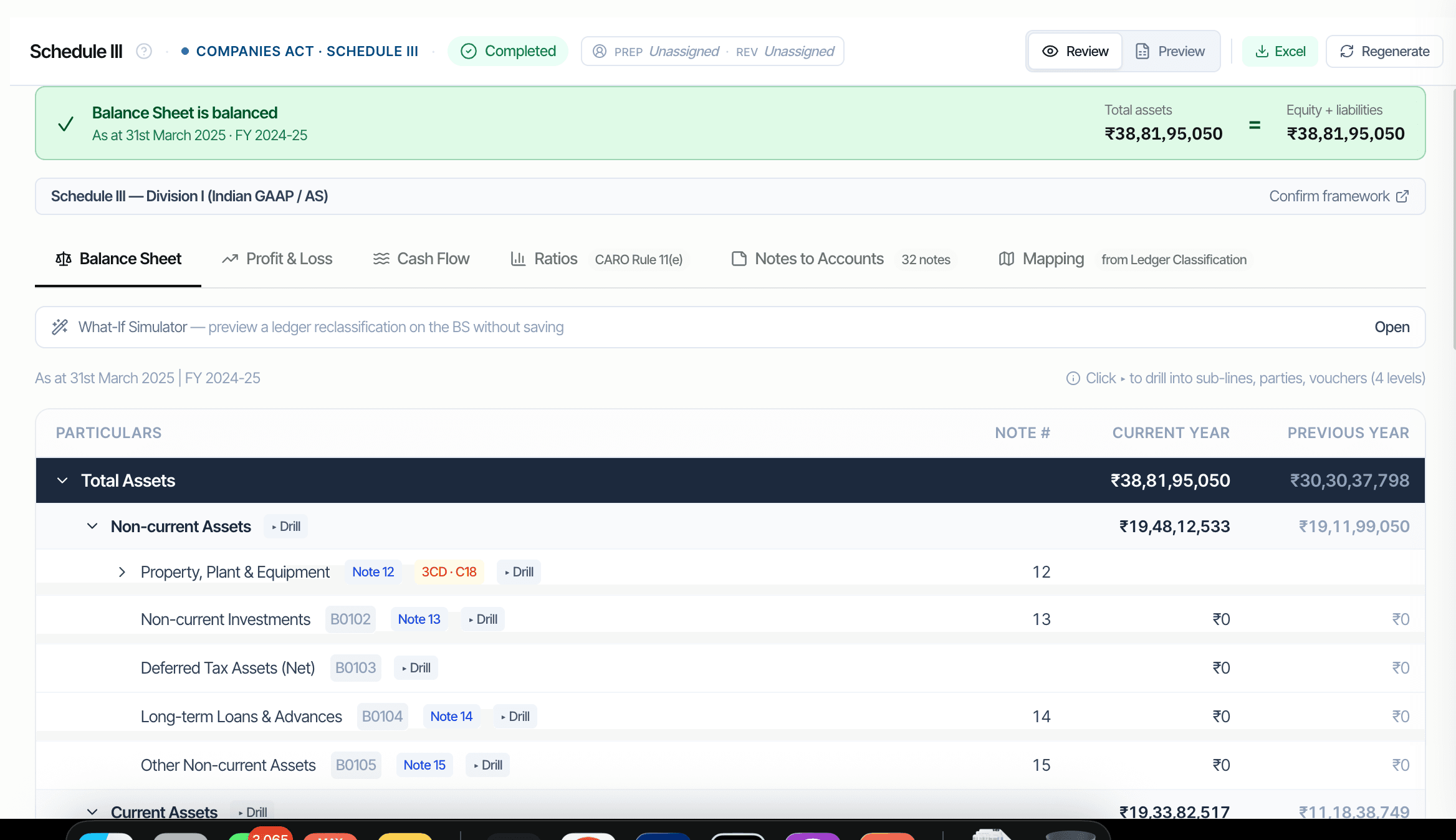
Every CF line drills to the constituent ଲେଜର୍ movement. The ଅଡିଟର୍ sees what feeds the line, can verify against the underlying ଲେଜର୍, and adjusts the classification if needed.

  • Per-line drill
  • ଲେଜର୍ movement underneath
  • Reclassification supported
  • ଅଡିଟ୍ trail per change
Frequently asked

Answers, up front.

The direct method (showing actual cash receipts and payments) is rarely used in India because it requires detailed cash-basis tracking that most accounting systems don't natively produce. CORAA's primary support is the indirect method per AS 3 and Ind AS 7. ସିଧାସଳଖ method support is on the roadmap.
Finance cost (interest ଖର୍ଚ୍ଚ) is added back to PBT in the Operating section (it's a non-cash adjustment from operating-cash perspective). Then deducted as an actual cash outflow in the Financing section (interest paid). This is the AS 3 / Ind AS 7 convention.
Realized FX differences flow through the P&L and feed into Operating cash flow naturally. Unrealized FX differences (translation adjustments) are added back to PBT as non-cash items. Per Ind AS 7, FX-arising-on-translation of cash and cash equivalents is shown separately, after the three activity sections.
See it on a real ledger

Run cash flow workings on one of your engagements.

Bring a Trial Balance and a General Ledger. We'll walk through working papers end-to-end on your data, not a sandbox.

Start the free trial →Book a walk-through
Cash Flow Statement AI for Statutory Audit | AS 3 / Ind AS 7 | CORAA | CORAA