CORAA
AI Modules/Findings/Findings Inbox
எங்கேஜ்மென்ட் Review Queue· निष्कर्ष

Findings Inbox

Auto-classified by materiality band. Articles triage, பங்குதாரர்கள் review.

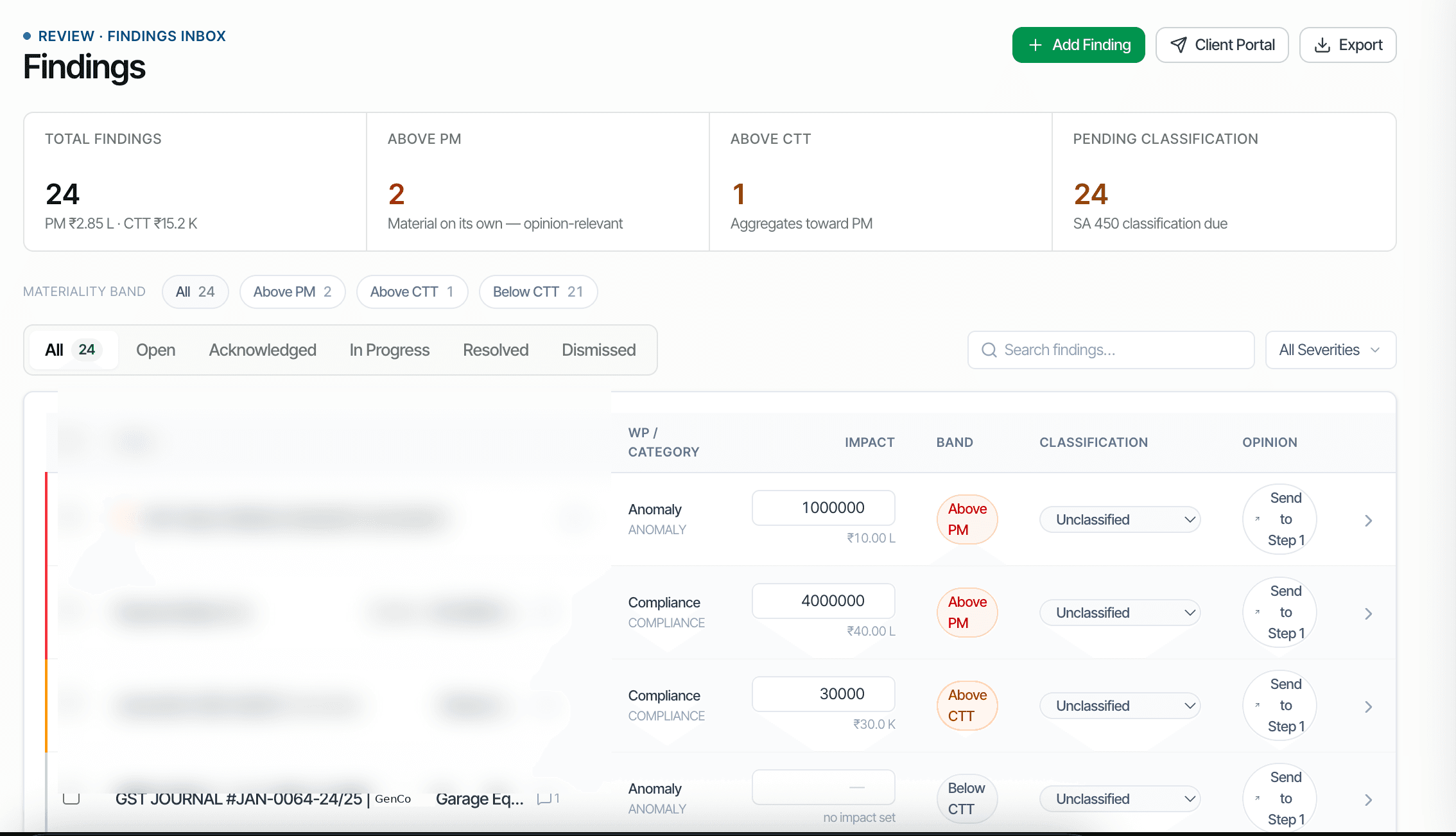
CORAA Findings inbox with materiality-band classification

Every voucher anomaly, every Schedule III mismatch, every threshold breach surfaces in the Findings inbox. CORAA auto-classifies each finding by materiality band using the locked Materiality memo: Above Performance Materiality (must resolve before sign-off), Above Clearly Trivial Threshold (review required), Below CTT (informational). Article assistants triage the lower bands; பங்குதாரர்கள் review the material ones.

  • Auto-classified by band: Above PM, Above CTT, Below CTT
  • Article-level filter for triage; partner-level filter for review
  • Above-PM findings block Opinion sign-off until resolved
  • Each finding: description, notes, attachments, linked vouchers, comments, version history
  • Resolve, Dismiss, Dismiss-family, Pin for partner attention
  • Findings flow into Opinion & Report Step 1 for classification
Two paths, one ledger

The old way, and ours.

Two paths to the same audit conclusion. One leaves traces; the other doesn't.

Traditional

The old way

  • -Anomalies tracked in an Excel sheet per audit
  • -Classification by materiality done manually at sign-off
  • -பங்குதாரர் reviews everything because triage isn't structured
  • -Resolved findings noted as 'cleared' without documented rationale
Findings management: ad-hoc. பங்குதாரர் review burden: 100% of all flags.
CORAA

On the Ledger

  • Findings auto-classified the moment they are created
  • Article triages Below-CTT findings without partner review
  • பங்குதாரர் reviews only Above-PM and Above-CTT findings
  • Each finding's full history preserved: who, when, what, why
  • Dismiss-family suppresses the pattern for that எங்கேஜ்மென்ட் permanently
Findings management: structured. பங்குதாரர் review burden: 5-20% of flags.
How it works

Three steps. Every trace logged.

Step 01

Auto-classification on creation

Every finding from Scrutiny, ஒத்திசைவு, or கணக்காய்வாளர் flagging carries an amount. CORAA classifies it against the locked Materiality memo: amounts above Performance Materiality go to Above-PM; above Clearly Trivial Threshold but below PM go to Above-CTT; below CTT go to Below-CTT (informational only).

Step 02

Triage and review

Articles open the Findings inbox filtered to Below-CTT. They review each finding's source voucher, accept or dismiss, document the rationale. பங்குதாரர்கள் filter to Above-PM and Above-CTT for their review.

Step 03

Resolution and sign-off

Above-PM findings must be resolved (or formally accepted as Uncorrected Misstatement per SA 450) before Opinion sign-off proceeds. The Findings inbox surfaces unresolved Above-PM findings as Opinion sign-off blockers.

Inside the module

What you actually get.

Three materiality bands

Bands derived from the locked Materiality memo. Configurable via SA 320 percentages.

  • Above PM: material misstatement candidate
  • Above CTT: warrants disclosure or correction
  • Below CTT: informational; no action required
  • Drill from band to individual findings

Finding as structured record

Each finding is more than a flag. It carries description, கணக்காய்வாளர் notes, attachments (invoices, emails, screenshots), linked vouchers, comments thread, and version history.

  • Description and கணக்காய்வாளர் notes
  • Attachments (drag-drop upload)
  • Linked vouchers (1+)
  • Comments thread for குழு discussion
  • Version history per edit

செயல்கள்

Five primary actions per finding.

  • Resolve: வாடிக்கையாளர் provided ஆதாரம், issue cleared
  • Dismiss: not a finding (false positive)
  • Dismiss-family: suppress pattern permanently for that எங்கேஜ்மென்ட்
  • Pin: flag for partner attention
  • Send to வாடிக்கையாளர்: convert to வாடிக்கையாளர் Portal question

Sign-off blocker integration

Unresolved Above-PM findings block Opinion & Report Step 1 from completing. The Findings inbox surfaces this as 'X findings above PM, must classify before sign-off'.

  • Above-PM blocker count
  • Direct link to unresolved findings
  • Block enforced on UDIN issuance
  • SA 450 disposition per finding required
Frequently asked

Answers, up front.

Three sources: (1) தானாகவே from Scrutiny rules firing on vouchers, (2) தானாகவே from ஒத்திசைவு variances exceeding tolerance, (3) manually by the கணக்காய்வாளர் flagging a voucher with the Flag-for-Review modal. Each source preserves attribution in the finding record.
Suppresses the underlying pattern for that எங்கேஜ்மென்ட் permanently. Example: dismissing a 'Sunday cash transaction' finding as a family for an automobile dealer (because Sunday is a sales day in that வணிகம்) prevents Sunday-cash flags for that வாடிக்கையாளர் thereafter. The rule continues running on other வாடிக்கையாளர்கள்; the dismissal is எங்கேஜ்மென்ட்-scoped. The dismissal reason is logged and reversible.
Opinion & Report Step 1 requires classification of every finding per SA 450: Resolved (issue cleared), Caveat (disclosed in IAR), Uncorrected Misstatement (கணக்காய்வாளர் agrees disposition but வாடிக்கையாளர் did not correct), Material Weakness (significant internal control issue). Above-PM findings must reach one of these classifications before Step 1 advances. Findings below CTT are auto-classified Resolved and don't block.
See it on a real ledger

Run findings inbox on one of your engagements.

Bring a Trial Balance and a General Ledger. We'll walk through findings end-to-end on your data, not a sandbox.

Start the free trial →Book a walk-through
Audit Findings Inbox AI | Materiality Band Classification | CORAA | CORAA