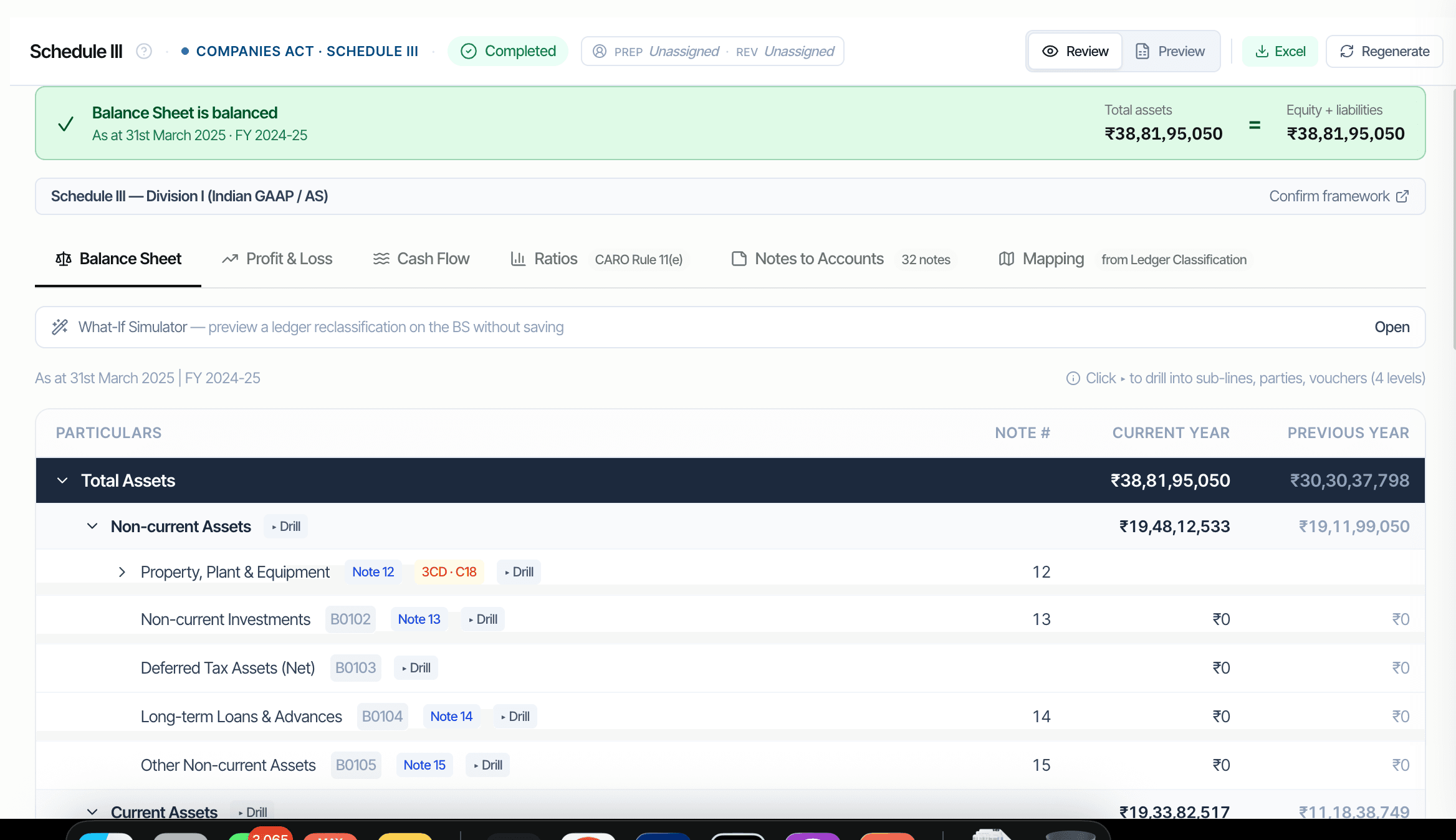
Schedule III is the heart of the financial statements — Balance Sheet, P&L, Cash Flow, ratios, depreciation, Notes and Mapping in one Working Paper. CORAA drafts every line from the books via Ledger Mapping. The framework stays a setting until you lock: switch Divisions and the faces re-render. When the equation ties, Lock & generate seals the statements and produces the Notes from the locked figures — so a note can never disagree with the face above it.
Two paths to the same audit conclusion. One leaves traces; the other doesn't.
Every ledger carries a Sch III line code from the 4-dim Ledger Mapping setup. BS and P&L compose via SUMIFS over Trial Balance, aggregating by Sch III line. Cash Flow derives from BS movement plus P&L non-cash adjustments.
BS, P&L, Cash Flow (indirect method), Ratios (the 11 Schedule III ratios with 25% variance flagging), Notes (32 disclosures with CY vs PY), Mapping (read-only view of classification).
The framework choice is a setting until you lock — switch Divisions and the faces re-render; move a grouping and the statements recompute. When the placements are confirmed and the equation ties, Lock & generate seals the statements and produces the Notes from the locked figures. Unlock, adjust, re-lock — version history keeps every generated set.
Balance Sheet, P&L, Cash Flow (indirect), Ratios, Schedule II Depreciation, Notes to Accounts, Disclosures, and Mapping (read-only from Ledger Mapping). Every figure recomputes from the mapped ledgers — re-map and regenerate; nothing is keyed by hand.
Most companies use Division I (Indian GAAP / AS); listed and large unlisted entities use Division II (Ind AS); NBFCs follow Division III; LLPs and non-corporate entities get their own formats. The framework selector switches the template, line names and disclosures — and stays switchable until you lock.
Any face line opens to the groupings and ledgers behind it, then the parties, then the vouchers. Marginal placement calls get decided on evidence — and the Mapping tab records where every rupee landed.
Schedule III's General Instructions (2021 amendment) require disclosure of 11 financial ratios. CORAA computes them automatically and flags any ratio with more than 25% variance vs prior year, requiring auditor disclosure of the reason for variance.
The locked statement set exports as an Excel and DOCX pack ready for the working-paper file. Notes drawn from management representations rather than ledger data carry an explicit "auditor to confirm" tag, so judgement calls stay visibly separate from computed figures.