Will my clients have to stop using Tally or learn new software?
No. The accounts team keeps entering vouchers in Tally exactly as it does today. CORAA reads the books and gives the owner, the finance head or the reviewer a view they do not get from Tally screens. The people who open CORAA are the ones asking questions about the numbers, not the ones entering them.
How does CORAA connect to Tally?
Through a connector installed on a Windows or Mac machine on the client’s network. It reads the company data from Tally over the local network, so nobody exports reports or emails backups. We help with the first installation.
Does CORAA change anything in the client’s Tally data?
No. The connector reads the books. When an entry needs correcting, the accounts team corrects it in Tally and the next sync shows the result. CORAA keeps the flag and the note about what was asked and answered.
Where does the client’s data go, and is it used to train AI?
Client data is hosted in India and is not used to train AI models. CORAA is ISO 27001:2022 certified, and a SOC 2 Type II audit is in progress. We sign a non-disclosure agreement with the client on request. The Trust Centre lists the commitments in full.
AI tools give wrong answers. Why would a client trust these numbers?
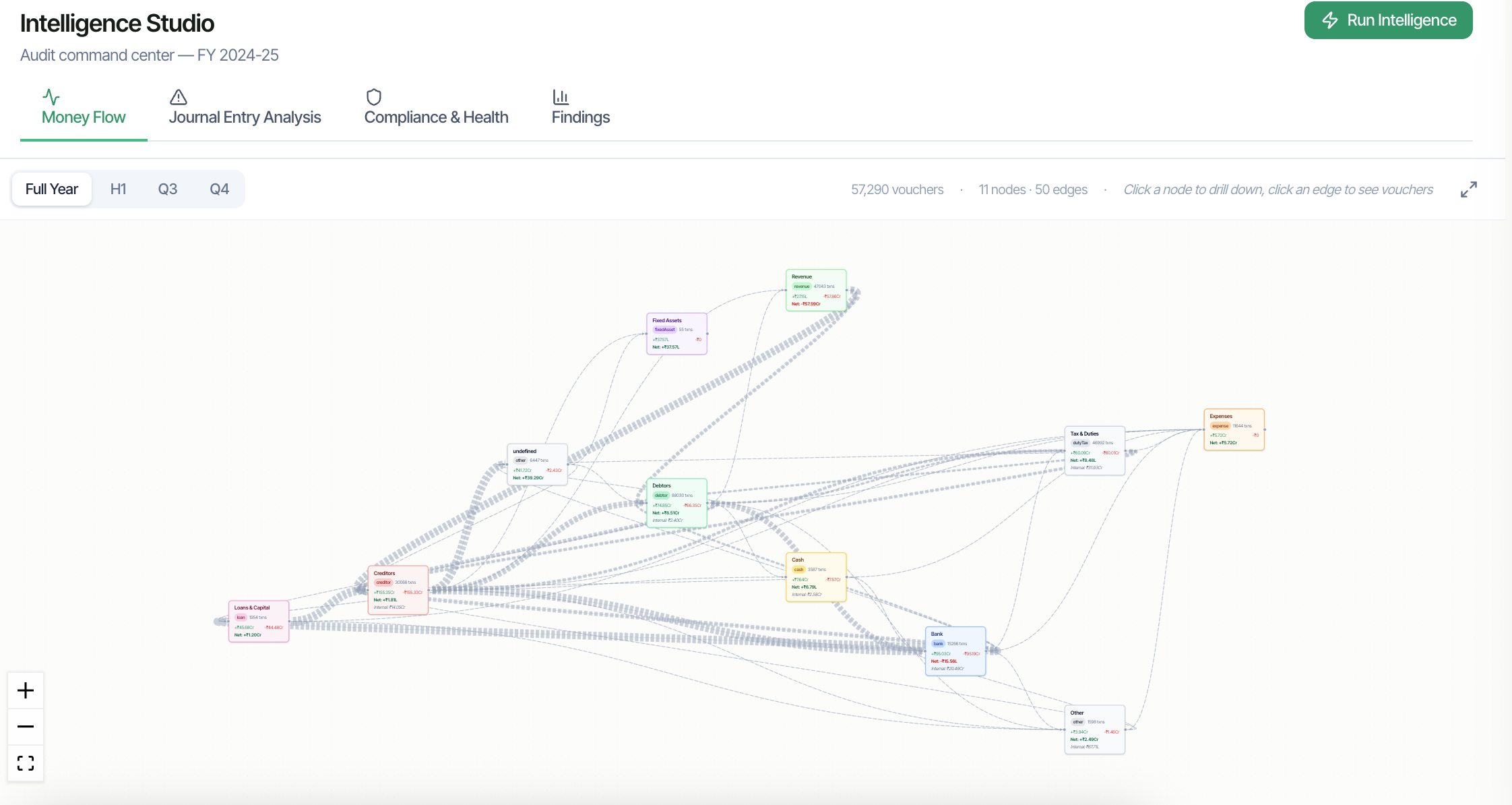
Because the figures are computed from the books, not written by a chatbot from memory. Every number opens to the vouchers behind it, with the voucher number, the ledgers and the narration. If a point cannot be traced to entries, it is not presented as a finding.
Who certifies what CORAA shows?
Nobody, and it does not need certifying. CORAA points to the entries and balances that deserve a second look and shows the trail behind each one. The owner, the finance head or their Chartered Accountant decides what it means. It is not an audit report or a certificate.
Can an owner use it as a regular check on the books without calling the CA each time?
Yes. That is the common starting point: an owner who is not sure the books are right. CORAA flags items such as cash payments above ₹10,000, cash receipts of ₹2 lakh or more, unusual entries and balances that have stayed overdue. Where the law requires an audit or an internal audit, that is still done by the appointed auditor.
Which clients should I approach first?
A client whose books are reasonably up to date, with an owner asking for better MIS or asking why profit is up and cash is tight, and someone on the finance side who will act on what they see. A business that only wants invoice customisation or mobile access needs a different add-on.
My client also uses Busy, Marg, Zoho Books or SAP. Does CORAA work there?
Tally has the dedicated connector. Zoho Books connects through a one-time authorisation. SAP, Busy and Marg come in through standard report exports in Excel. We confirm what is covered for the client’s system before anyone quotes.
Is CORAA a CRM, a collections tool or a TDL add-on?
None of these. It is not built to manage leads, send payment reminders or track AMC renewals, and nothing is installed inside Tally’s screens the way a TDL is. It shows which balances are overdue and for how long, and which transactions need review; the follow-up stays in the client’s own process.
How is it priced for my client, and what do I earn?
The client is quoted per company, per year, after we understand the setup. Your share follows the published sales-partner tiers on this page: 15% to 30% of eligible first-year value and 10% to 20% on renewal, depending on the tier.
Do I need to be a Tally reseller?
No. Consultants, CA and virtual-CFO firms, ERP specialists, technology businesses and professional networks can discuss a partnership with CORAA. Tell us who you work with and how you would like to contribute.
Can I apply if I work with Zoho, SAP, Odoo or another platform?
Yes. Your existing ecosystem does not limit the conversation. We confirm the supported import or connector, required data and implementation scope for each client. Naming an ecosystem here does not mean CORAA has an official partnership or a native integration with that vendor.
What happens in the first conversation?
We discuss the clients you serve, the business problem and your preferred role. For a sales partnership, we walk through the relevant product workflow and commercial terms. Technology collaborations start with the use case and a feasibility discussion. Client financial data is not required for this first conversation.
Do all partnerships use the same commission structure?
The published tiers apply to the sales-partner program. Referral arrangements, technology collaborations and other proposals are scoped individually. The applicable agreement defines eligible revenue, payment timing, renewals and lead registration before you commit.
Who handles demonstrations and support?
For the sales-partner program, CORAA joins your first three client calls to run the demo and answer product questions. Product support after setup sits with CORAA. Installation, training and any services delivered by your team are agreed as part of onboarding.
Can a CA firm use CORAA for its own engagements?
Yes. A firm buying CORAA for its own audit work can explore the audit product directly. If you want to introduce CORAA to other businesses or combine it with your services, tell us that in your partner inquiry.
Does sending an inquiry make me an approved partner?
No. The inquiry starts a conversation. We confirm fit, scope and the applicable agreement before onboarding. Use of partner branding or any representation of approved status follows that agreement.