CORAA
AI Modules/Procedures/Materiality
SA 320 · Procedure· विधि

Materiality

The ICAI band rendered. The rationale captured. Locked before fieldwork.

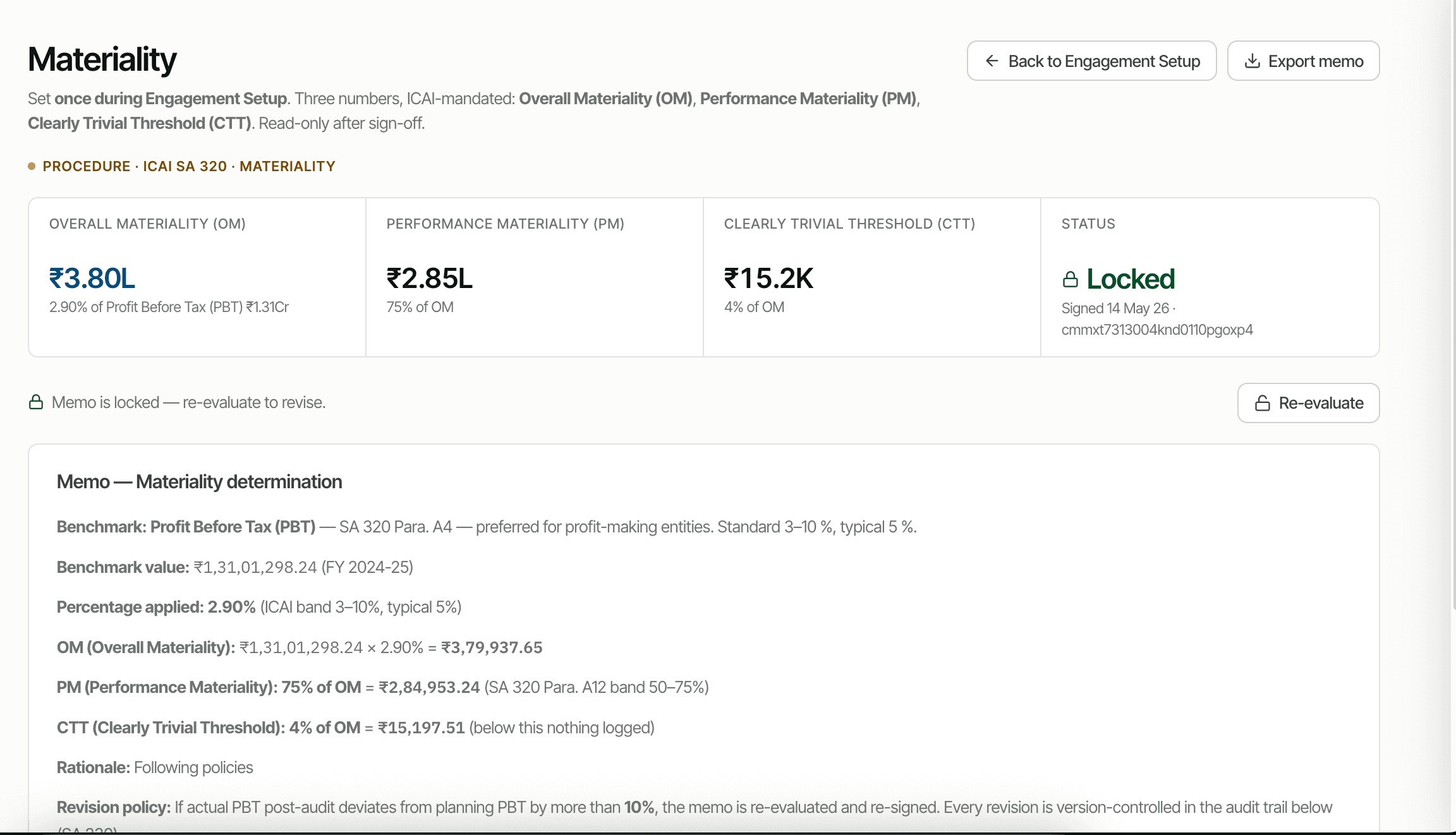
CORAA Materiality memo locked under SA 320

SA 320 mandates that materiality be set before fieldwork begins, documented with rationale, and locked. CORAA's three-step wizard guides the benchmark choice, PBT, Turnover, or Equity, applies the percentage, derives Performance Materiality and Clearly Trivial Threshold, and locks the memo. Out-of-band percentages require written rationale captured in the audit trail per SA 230.

  • Step 1: pick benchmark, PBT (3-10% typical), Turnover (0.5%), Equity (1-2%)
  • Step 2: pick percentage with the ICAI 3-10% band shaded on the slider
  • Step 3: derive PM (50-75% of OM per SA 320 A12) and CTT (typically 5% of OM)
  • Out-of-band selections require written rationale logged to the audit trail
  • Memo locked before fieldwork, consumed by Sampling, Findings, Opinion
  • Revision triggers a documented re-evaluation note per SA 230
Two paths, one ledger

The old way, and ours.

Two paths to the same audit conclusion. One leaves traces; the other doesn't.

Traditional

The old way

  • -Materiality calculated on a sheet of paper, often without written rationale
  • -Benchmark choice (PBT vs Turnover vs Equity) made on instinct, not documented
  • -Off-band percentages used without explanation
  • -PM and CTT rarely separated; sampling done at OM level
  • -Materiality 'adjusted' mid-engagement without trail
Falls apart under NFRA inspection. Peer reviewers cannot retrace the auditor's logic.
CORAA

On the Ledger

  • Benchmark selection captured with the basis (profit-making, loss-making, listed)
  • Percentage on a slider with ICAI 3-10% band shaded, visual guidance
  • PM and CTT derived automatically with explicit ratios
  • Off-band selections force a written rationale before locking
  • Locked memo is read-only, revision requires a documented note
  • Every change captured in the audit trail per SA 230
Defensible under NFRA inspection and peer review. Every judgment retraceable.
How it works

Three steps. Every trace logged.

Step 01

Pick the benchmark

Three choices: Profit Before Tax (typical 3-10% for profit-making entities), Turnover (0.5% for loss-making, SME, or volatile-PBT entities), or Equity (1-2% for investor-led entities). CORAA renders all three benchmark values from the financials and recommends the lowest for listed entities.

Step 02

Pick the percentage

A slider with the ICAI 3-10% band shaded. Selections inside the band require no rationale. Selections outside the band require a written justification before the wizard advances. Resulting Overall Materiality renders immediately.

Step 03

Derive PM and CTT

Performance Materiality at 50-75% of OM (SA 320 A12), 75% default for low-risk engagements, 50% for higher-risk. Clearly Trivial Threshold at typically 5% of OM. Both rendered on sliders. Lock the memo when satisfied.

Inside the module

What you actually get.

ICAI band shaded on the slider

SA 320 suggests 3-10% of PBT as the typical band. CORAA's slider renders the band visually, selections inside don't trigger the rationale requirement; selections outside the band force a written justification.

  • Band rendered on PBT, Turnover, and Equity sliders
  • Out-of-band triggers a rationale modal
  • Rationale stored in the audit trail per SA 230

Locked memo, audit-trailed

Once locked, the materiality memo is read-only. Sampling, Findings classification, and Opinion sign-off all consume the locked numbers. Revision requires a documented re-evaluation note explaining what changed and why.

  • Memo immutable after lock
  • Revision tracked with reason
  • Original and revised versions both preserved
  • Engagement Log captures every event

PM and CTT derived from OM

Performance Materiality (PM) is the buffer used for individual procedures, 50-75% of Overall Materiality per SA 320 A12. Clearly Trivial Threshold (CTT) is the de minimis floor, typically 5% of OM. CORAA derives both with explicit ratios and lets the auditor adjust within the band.

  • PM: 50-75% of OM, default 75% for low-risk
  • CTT: typically 5% of OM, range 3-10%
  • Both feed Findings classification: Above PM, Above CTT, Below CTT
  • Sampling consumes PM as its denominator

Defensible under NFRA inspection

The memo and audit trail satisfy NFRA inspection and peer review requirements, benchmark choice documented, percentage band-justified, PM/CTT rationale captured, every revision time-stamped per SA 230.

  • SA 320 paragraph anchors per choice
  • SA 230 documentation requirements met
  • Peer review ready, full retrace possible
  • NFRA inspection ready
Frequently asked

Answers, up front.

SA 320 explicitly requires materiality to be set before fieldwork begins. Once sampling, findings classification, and Opinion sign-off rely on the number, it cannot quietly change. CORAA enforces the lock; revision requires a documented re-evaluation note per SA 230. The locked memo is what makes the working paper defensible under NFRA inspection or peer review.
PBT-based materiality on a loss-making entity is volatile and not typically appropriate. CORAA recommends Turnover (0.5% of revenue) for loss-making entities, SMEs, and businesses with cyclical PBT. The wizard surfaces this recommendation when PBT is negative or near zero. The benchmark choice is the auditor's, but CORAA documents the reasoning.
Default is 75% of OM for low-risk engagements (no prior-year audit qualifications, documented internal controls, limited estimates). 50% for higher-risk engagements (prior-year findings, weak controls, significant estimates). The slider lets the auditor pick within the SA 320 A12 band of 50-75% with the rationale captured.
Yes, but only with a documented re-evaluation. CORAA prompts a re-evaluation note when actual PBT (post-audit) deviates from planning PBT by more than 10%, typically when significant misstatements are found that shift the benchmark. The original memo and the revised memo are both preserved; the audit trail shows what changed and why.
See it on a real ledger

Run materiality on one of your engagements.

Bring a Trial Balance and a General Ledger. We'll walk through procedures end-to-end on your data, not a sandbox.

Start the free trial →Book a walk-through
Materiality (SA 320), Three-step Wizard, Locked Memo | CORAA | CORAA